
Nixtla logo
Rank #765
FREEMIUM SELF HOSTED #1 in Time Series Forecasting State of the Art

Nixtla Review — Time Series Forecasting

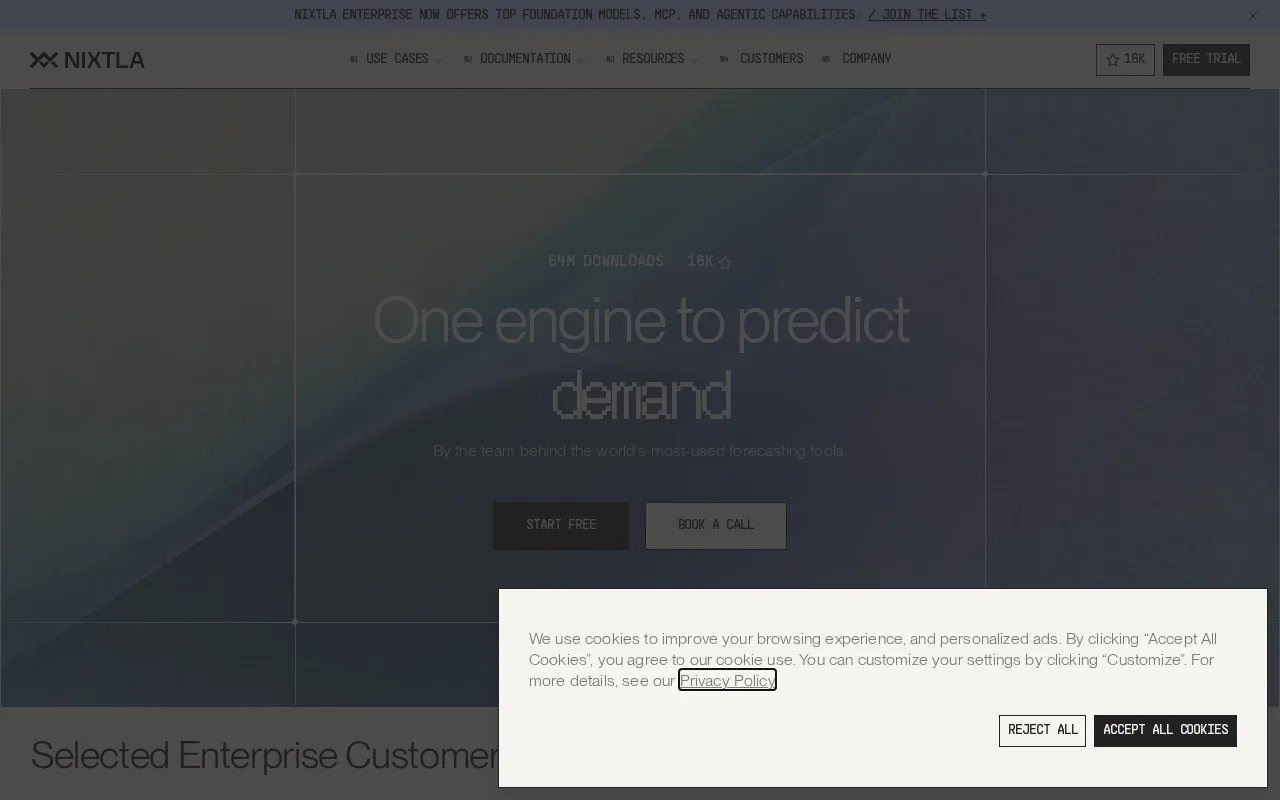
Open-source Python libraries for time series forecasting, feature engineering, and evaluation with pandas and PyTorch.
35 monthly visitors 3.9K GitHub stars 35 page views (30d)
Reviewed by Volvenix Editorial
7.5
Volvenix Verdict
AI-powered editorial review
Nixtla
A solid open-source toolkit for time series forecasting with strong Python integration.
PROS
  • Strong integration with pandas and PyTorch
  • Modular and extensible design
  • Open-source with active community
  • Includes feature engineering and evaluation tools
  • Supports multiple forecasting models
CONS
  • Requires intermediate Python and ML knowledge
  • No managed SaaS offering

Is Nixtla Right for You?

A quick checklist to help you decide.

You build forecasting models using pandas and PyTorch in Python environments.
You need a fully managed SaaS forecasting platform with minimal setup.
You want open-source tools that integrate well with existing Python data workflows.
Free-tier limits are a blocker for your production forecasting needs.
Your team requires modular and extensible time series forecasting libraries.
You require a no-code or beginner-friendly forecasting solution.

Ideal for: Data scientists and ML engineers who build custom forecasting pipelines using Python and prefer open-source tools.

Less suited for: Users seeking turnkey SaaS forecasting solutions or those without Python expertise should avoid this tool.

Bottom line: Open-source Python libraries focused on modular, customizable time series forecasting pipelines.

Editorial Review AI-generated
Nixtla provides a comprehensive set of open-source tools tailored for time series forecasting, focusing on usability with pandas DataFrames and PyTorch. Its modular architecture allows users to customize and extend forecasting pipelines easily. While it excels in flexibility and integration, it may require intermediate Python and ML knowledge, limiting accessibility for beginners. The lack of a commercial SaaS platform means users must manage their own infrastructure, which suits teams comfortable with open-source environments.

AI-assessed from 4 sources.

Pros & Cons

Pros

Open-source with transparent, reproducible models
Strong Python ecosystem integration
Modular and extensible architecture
Wide range of forecasting techniques supported
Good integration with Python and data science tools
Open-source with active development
Includes feature engineering and evaluation
Scalable for large datasets and production use
Active community and growing documentation
Supports multiple forecasting models

Cons

No dedicated user interface for non-technical users moderate
Workaround: Use Python scripts or integrate into custom apps
Requires intermediate Python and ML skills moderate
Workaround: Use tutorials and community resources to learn basics
Limited enterprise support and SLAs moderate
No managed SaaS platform available moderate
Workaround: Self-host or integrate with own infrastructure
Limited official commercial support minor
Workaround: Rely on community forums and open-source contributions
No official public API documented minor
Who Is It For & What Can It Do
Best For
Developer / Engineer Data Scientist / Analyst Product Manager Advanced curve
AI Capabilities
Code Execution Feature Extraction Model Evaluation Predictive Analytics Tool Calling
Key Features
Open-source model
Access to multiple forecasting algorithms
Time series forecasting
Multiple open-source forecasting models
Python integration
Seamless use within Python data science workflows
Feature engineering
Tools for time series feature extraction and transformation
Evaluation & metrics
Built-in evaluation and backtesting tools
Scalability
Designed to handle large time series datasets
Integrations
Works seamlessly with pandas and PyTorch
Cloud deployment
Hosted environment for running models
Community Support
Access to forums and GitHub discussions
Commercial Support
Optional paid support and services
Best Use Cases
Building custom time series forecasting pipelines Forecasting sales and demand trends Feature engineering for time series data Predicting financial time series Energy consumption forecasting Evaluating forecasting model performance Research and experimentation with forecasting models Inventory and supply chain planning Integrating forecasting into Python data workflows Research and development of forecasting models
Available Platforms
Integrations
Pandas PyTorch
Inputs & Outputs
Spreadsheetinput Spreadsheetoutput
Supported Languages
English English
Security & Compliance
Compliance Standards
GDPR
Privacy · EU
API & Developer Tools
Pricing Plans

Free

Best for individuals

Free
 
  • Access to open-source libraries
  • Community support

Team

For small teams

$30/mo
$30.00/mo billed annually
  • Team collaboration features
  • Extended support

Free open-source libraries with optional paid services; core tools are free to use with no cost.

Price Range
Free $0–$0
Support Channels
Did you find this page helpful?
Frequently Asked Questions
What is this tool?
Nixtla is an open-source Python toolkit for time series forecasting, feature engineering, and evaluation.
What is this tool?
Nixtla (TimeGPT) is an open-source platform offering scalable time series forecasting models for data scientists.
How much does it cost?
Nixtla offers free open-source libraries with optional paid services for additional features and support.
How much does it cost?
Nixtla offers a free open-source tier; paid plans for enhanced features may be available.
Does it have a free plan?
Yes, the core libraries are free and open-source with community support.
Does it have a free plan?
Yes, the core forecasting models are available for free as open-source software.
What integrations does it support?
Nixtla integrates primarily with pandas and PyTorch in Python environments.
What integrations does it support?
It integrates primarily with Python data science tools and workflows.
Who is it best for?
It is best for data scientists and ML engineers building forecasting pipelines using Python.
Who is it best for?
It is best suited for data scientists and ML engineers needing customizable forecasting models.
User Reviews

No reviews yet. Be the first to review Nixtla!

Write a Review
Discussion
No discussions yet. Start the conversation!
0 tools selected
Compare Now →
Nixtla Visit Tool