
Axolotl logo
Rank #483
FINE-TUNING AS A SERVICE FREEMIUM SELF HOSTED #1 in Fine-Tuning as a Service State of the Art

Axolotl Review — Efficient LLM Fine-Tuning

Axolotl is an open-source framework for fine-tuning large language models with LoRA and PEFT techniques.
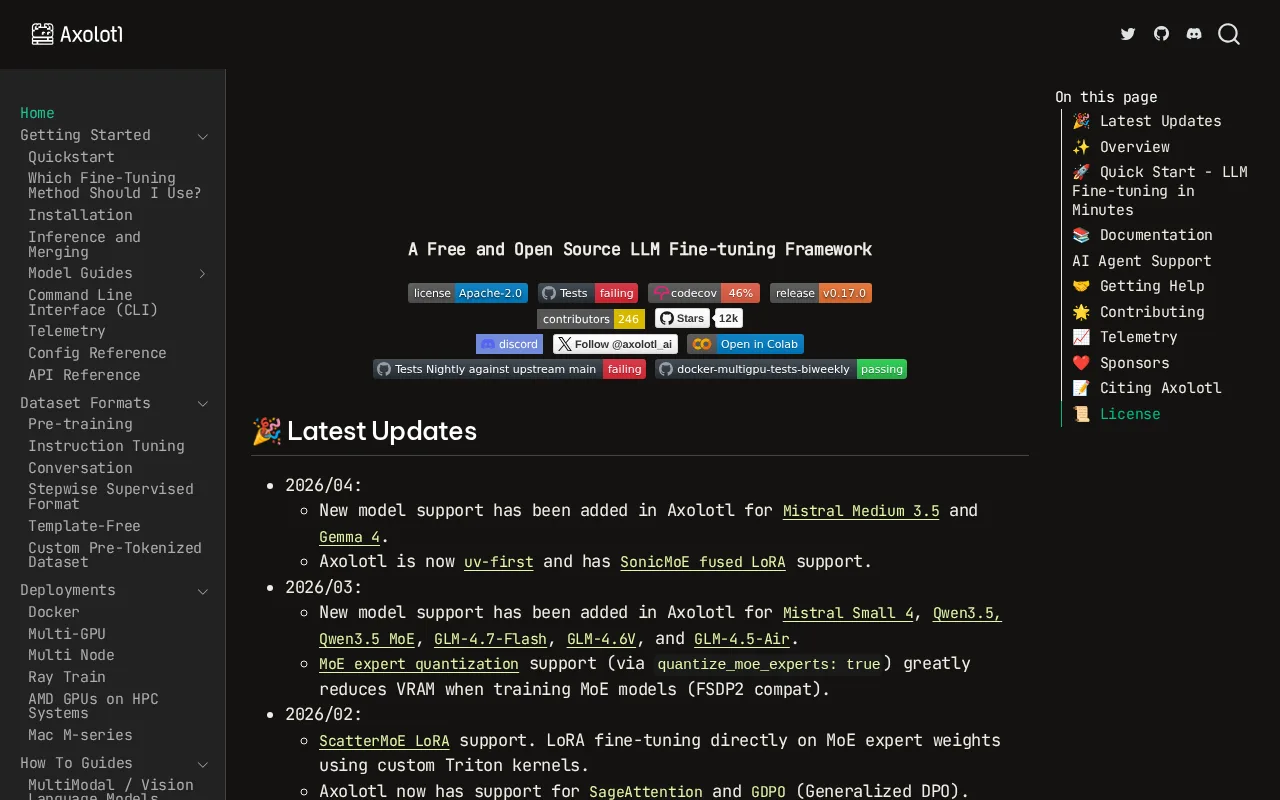
Axolotl — preview
7.8
Volvenix Verdict
AI-powered editorial review
Axolotl
Axolotl is a powerful open-source tool for efficient fine-tuning of large language models with strong community support.
PROS
  • Open-source with active community
  • Supports parameter-efficient fine-tuning (LoRA, PEFT)
  • Modular and extensible architecture
  • Efficient resource usage for large models
  • Comprehensive documentation
CONS
  • Requires technical expertise to use effectively
  • No managed or hosted service option

Is Axolotl Right for You?

A quick checklist to help you decide.

You want to fine-tune large language models efficiently with minimal compute resources
You require a fully managed fine-tuning service with minimal setup
You need an open-source framework that supports LoRA and PEFT techniques
Free-tier limits or lack of commercial support are blockers for your project
Your team has technical expertise to manage and customize fine-tuning workflows
You prefer a no-code or low-code solution for model fine-tuning

Ideal for: Developers and researchers needing an open-source, flexible framework for efficient fine-tuning of large language models using LoRA and PEFT.

Less suited for: Non-technical users or teams seeking fully managed, no-code fine-tuning services should avoid this tool due to its technical complexity and self-hosted nature.

Bottom line: Open-source, parameter-efficient fine-tuning framework with strong community and modular design.

Editorial Review AI-generated
Axolotl excels in enabling parameter-efficient fine-tuning of large language models, making it accessible for researchers and developers with limited compute resources. Its open-source nature and modular architecture foster community contributions and flexibility. However, it requires technical expertise to set up and use effectively, limiting its appeal to non-technical users. The documentation is comprehensive but can be overwhelming for beginners. Overall, it is best suited for teams focused on research or custom model adaptation who want control over the fine-tuning process.
Pros & Cons

Pros

Open-source with permissive license
Efficient fine-tuning with LoRA and PEFT
Strong community and active development
Modular design for customization
Good documentation and tutorials

Cons

Steep learning curve for beginners moderate
Workaround: Follow official tutorials and community guides
No hosted or managed service option major
Who Is It For & What Can It Do
Best For
Developer / Engineer Data Scientist / Analyst Advanced curve
AI Capabilities
Model Training
Key Features
LoRA Fine-Tuning
Supports Low-Rank Adaptation for efficient tuning
PEFT Techniques
Parameter-Efficient Fine-Tuning methods supported
Modular Architecture
Flexible components for custom workflows
Multi-model Support
Compatible with various LLM architectures
Community Tutorials
Extensive guides and examples
Best Use Cases
Fine-tuning large language models with limited compute Research on parameter-efficient tuning methods Customizing open-source LLMs for specific tasks Experimenting with LoRA and PEFT techniques Building scalable fine-tuning pipelines
Available Platforms
Inputs & Outputs
Textinput Textoutput
Supported Languages
English
Security & Compliance
API & Developer Tools
Pricing Plans

Axolotl is free and open-source with optional paid managed services available from third parties.


Price Range
Free $0–$0
Support Channels
Did you find this page helpful?
Frequently Asked Questions
What is this tool?
Axolotl is an open-source framework for efficient fine-tuning of large language models using LoRA and PEFT.
How much does it cost?
Axolotl is free to use as an open-source project with no cost.
Does it have a free plan?
Yes, Axolotl is entirely free and open-source.
What integrations does it support?
Axolotl integrates with popular ML frameworks like PyTorch and supports various LLM architectures.
Who is it best for?
It is best suited for developers and researchers with technical expertise in model fine-tuning.
User Reviews

No reviews yet. Be the first to review Axolotl!

Write a Review
Discussion
No discussions yet. Start the conversation!
0 tools selected
Compare Now →
Axolotl Visit Tool