 Volvenix
Make vs Zapier
AI-enhanced independent comparison — features, pros, cons, pricing and rankings.
 ChatGPT
  Claude
  Gemini
  Midjourney
  DALL-E
  Stable Diffusion
  Notion AI
  Canva
Canva  Grammarly
  GitHub Copilot
  ElevenLabs
  Perplexity
  Runway
  Synthesia
  Fireflies.ai
  Hugging Face Hub

| Dimension | Make | Zapier |
|---|---|---|
| Accuracy & Reliability | ||
| Ease of Use | ||
| Features & Capability | ||
| Value for Money | ||
| Performance & Speed | ||
| Popularity & Adoption |
Who each tool serves best — and when to pick the other one.
Teams in operations, marketing, sales, or IT who need to automate complex workflows visually without coding.
- You need to automate complex workflows involving multiple apps without coding
- You want a visual interface to design and monitor your automations
- Your team requires integrations across marketing, sales, IT, and operations tools
Users seeking simple one-step automations or those unwilling to invest time learning a visual builder.
- You need only simple, single-step automations with minimal setup
- Free-tier limits are a blocker for your automation volume or team size
- You require extensive enterprise security features like SSO or MFA
The ability to visually design and control multi-step workflows without coding.
Non-technical users, small businesses, and teams wanting to automate repetitive tasks across multiple apps without coding.
- You want to automate repetitive tasks without writing code or scripts
- You need to connect multiple cloud apps to streamline workflows
- Your team requires a simple, visual interface for building automations
Users needing complex custom automations, enterprise-grade security features, or those with strict budget constraints on paid plans.
- You need enterprise-grade security and compliance features
- Free-tier limits are a blocker for your automation volume needs
- You require highly customized or complex automation logic
The breadth of app integrations and ease of use for non-technical workflow automation.
A canonical comparison across capabilities common to this category. Vendor-specific extras appear below in "Highlighted Features".
| Capability | Make | Zapier |
|---|---|---|
|
Free Tier Available
Usable without payment (with usage limits)
|
✓ | ✓ |
| Feature | Make | Zapier |
|---|---|---|
| App Integrations | Connects to hundreds of apps and services | Connects with 5,000+ apps |
Each tool's marketing-listed features. Where a feature appears under one tool but not the other, it usually reflects how the vendor describes their product — not a definitive capability gap.
- Visual workflow builder — Drag-and-drop interface to create workflows
- Multi-Step Automation — Supports complex workflows with multiple steps
- Advanced Scheduling — Set triggers and schedules for workflows
- Error Handling — Manage and retry failed workflow steps
- No-code workflow builder — Drag-and-drop interface for automation
- Multi-Step Zaps — Supports complex workflows with multiple steps
- Conditional Logic — Add filters and paths to workflows
- Task History — View logs of automation runs
- Visual drag-and-drop workflow builder
- Supports complex multi-step automations
- Extensive app integrations
- Good monitoring and observability tools
- Flexible freemium pricing
- Supports over 5,000 app integrations
- No-code automation builder with drag-and-drop UI
- Multi-step workflows with conditional logic
- Strong community and extensive documentation
- Reliable cloud-based platform
- Steep learning curve for new users
- Some advanced features require paid plans
- No native mobile app for workflow management
- Limited advanced customization for complex workflows
- Pricing escalates quickly with higher task volumes
- No official mobile app for building automations
- Automate marketing campaign workflows
- Streamline sales lead management
- Integrate IT service operations
- Synchronize data across cloud apps
- Monitor and alert on workflow failures
- Automate email notifications
- Sync data between CRM and marketing tools
- Schedule social media posts
- Generate reports from spreadsheets
- Trigger alerts from form submissions
Natural languages each tool generates and understands. Primary languages are listed first.
What each tool can accept (input) and produce (output) — text, image, audio, video, code.
Free tier available with limits; paid plans unlock higher usage and advanced features.
-
Free
Free -
Core
popular
$9.00/mo -
Pro
$29.00/mo
Zapier offers a free tier with basic features and paid plans that unlock higher task limits and advanced features.
-
Free
Free -
Starter
popular
$19.99/mo -
Professional
$49.00/mo
Regulatory frameworks each tool claims compliance with (HIPAA, SOC 2, GDPR, etc.).
Vendor-published numbers each tool highlights — usage scale, breadth, and operational stats. Different tools track different metrics, so direct row-by-row comparison usually isn't meaningful.
- Operations per month Up to 100,000+
- Active workflows Unlimited on paid plans
- Tasks automated per month 100+
Who each tool is positioned for — primary audience first.
How you can reach support — email, live chat, phone, community, docs.
- Documentation primary visit ↗
- Documentation primary
How each tool is classified in the Volvenix catalog.
These vocabulary domains are managed in our catalog but not yet exposed at the tool level. We're tracking them for future expansion of this comparison.
- Encryption Types — AES-256, ChaCha20, RSA-2048, and similar at-rest/in-transit cipher families.
- Encryption Contexts — where encryption is applied (data at rest, in transit, end-to-end).
- Plan-tier Model Mapping — which AI models are available on which pricing tier (currently only the model list is tracked, not the per-plan availability).
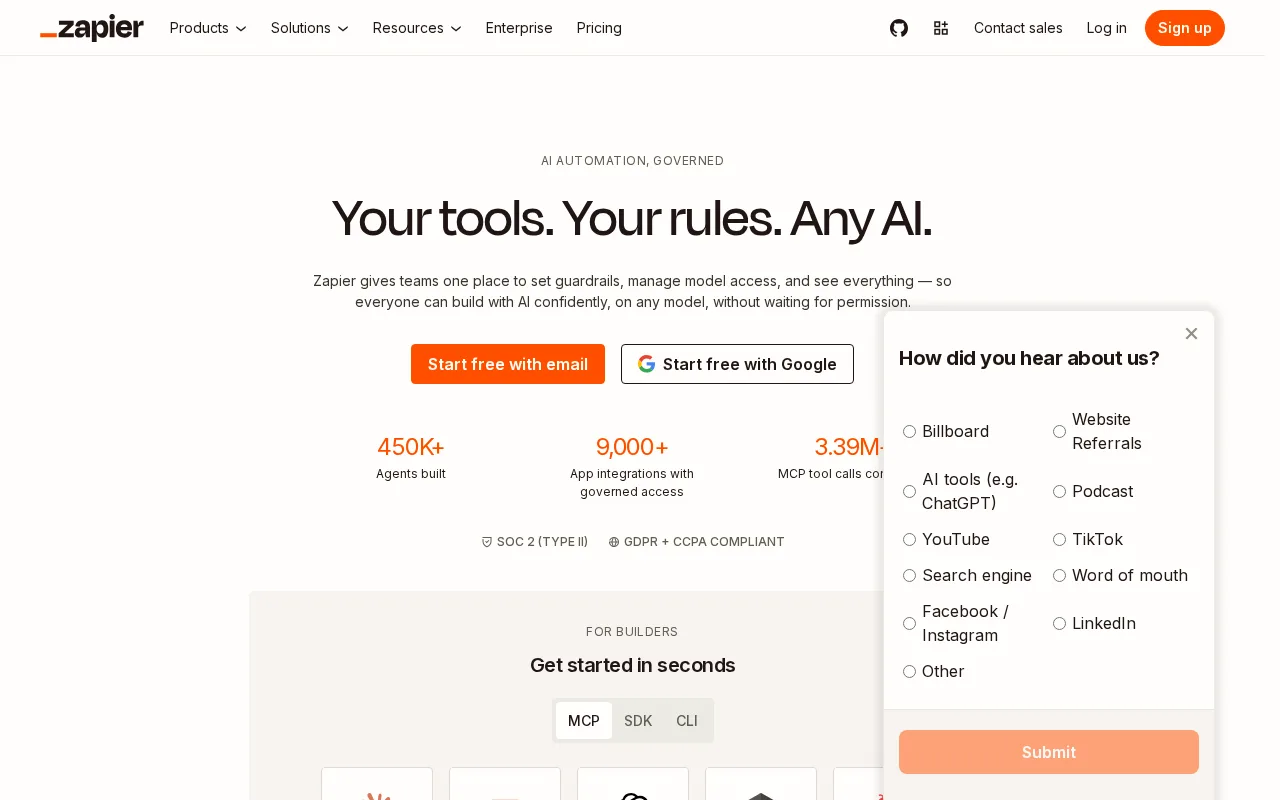
No screenshots uploaded yet.
- What is this tool?
- Make is a visual automation platform that connects apps into multi-step workflows without coding.
- How much does it cost?
- Make offers a free tier with limits and paid plans starting at $9/month for higher usage and features.
- Does it have a free plan?
- Yes, Make provides a free plan with 1000 operations per month and 3 active workflows.
- What integrations does it support?
- Make supports hundreds of app integrations including popular marketing, sales, and IT tools.
- Who is it best for?
- It is best for teams in operations, marketing, sales, and IT needing customizable workflow automation.
- What is this tool?
- Zapier is a no-code automation platform that connects apps to automate workflows.
- How much does it cost?
- Zapier offers a free plan and paid subscriptions starting around $20/month.
- Does it have a free plan?
- Yes, Zapier provides a free tier with limited tasks and single-step automations.
- What integrations does it support?
- Zapier supports over 5,000 app integrations including popular SaaS tools.
- Who is it best for?
- It is best for individuals and small to medium businesses wanting easy automation.
| Info | Make | Zapier |
|---|---|---|
| Pricing | Freemium | Freemium |
| Category | AI Agents & Automation | AI Agents & Automation |
| Deployment | Cloud | Cloud |
| Learning Curve | Intermediate | Beginner |
| Free Plan | ✓ | ✓ |
| AI Agent | ✓ | ✓ |
| Autonomy | Agent | Assistant |
| Risk Tier | High | Medium |
| BYO API Key | — | ✓ |
| Local Models | — | ✗ |
| Fine-tuning | — | ✗ |
 Apache Airflow
 Nekton AI
 Valohai
 Celigo
 KNIME Analytics Platform
 Parabola
 MultiOn
 Workato
Make and Zapier both offer freemium pricing models and automation capabilities, with overall scores of 6/10 and 6.2/10 respectively. Make provides a visual, flowchart-style interface suited for complex, multi-step workflows, while Zapier focuses on ease of use with a simpler, trigger-action setup ideal for straightforward automations. Zapier supports a broader range of app integrations, making it suitable for users needing extensive connectivity, whereas Make appeals to those requiring detailed customization and advanced data manipulation.
ⓘ How Volvenix scores work
Scores are computed by Volvenix — not supplied by the vendors, and not third-party benchmark results. Each 0–10 dimension (Overall, Features, Usability, Support, Pricing) is a directional estimate aggregated from catalog signals — editorial cataloguing, content depth, engagement, and provider-reputation indicators — so treat them as a starting point, not a lab result.
Confidence reflects how complete the underlying data is for both tools; lower confidence means fewer signals were available, not a worse tool. We never accept payment for rankings or scores. More about how Volvenix works →