 Volvenix
Autify vs HARPA
AI-enhanced independent comparison — features, pros, cons, pricing and rankings.
 ChatGPT
  Claude
  Gemini
  Midjourney
  DALL-E
  Stable Diffusion
  Notion AI
  Canva
Canva  Grammarly
  GitHub Copilot
  ElevenLabs
  Perplexity
  Runway
  Synthesia
  Fireflies.ai
  Hugging Face Hub

| Dimension | Autify | HARPA |
|---|---|---|
| Accuracy & Reliability | ||
| Ease of Use | ||
| Features & Capability | ||
| Value for Money | ||
| Performance & Speed | ||
| Popularity & Adoption |
Who each tool serves best — and when to pick the other one.
QA teams, product managers, and developers at SMBs or enterprises needing scalable, low-code browser test automation.
- You need to automate browser tests without writing code or maintaining scripts.
- You want self-healing tests that adapt to UI changes and reduce manual updates.
- Your team requires scalable, cloud-based test execution across browsers and devices.
Highly technical teams requiring deep customization or integration with complex CI/CD pipelines may find it limiting.
- You need deep customization or scripting for highly complex test scenarios.
- Free-tier limits are a blocker for teams with large-scale or frequent test runs.
- You require on-premise deployment or advanced API integrations not supported by Autify.
Ease of use for non-coders and self-healing test maintenance.
Knowledge workers, marketers, and professionals who frequently extract web data and automate browser-based workflows.
- You want to automate repetitive web tasks without coding knowledge.
- You need to extract and summarize data directly from web pages efficiently.
- Your team requires browser-based automation integrated with AI prompts.
Users seeking a fully standalone automation platform or those uncomfortable with browser extensions and manual setup.
- You need a standalone desktop automation tool independent of browsers.
- Free-tier limits are a blocker for your extensive automation needs.
- You require deep integrations with third-party SaaS platforms out of the box.
The ability to combine AI-driven content understanding with browser automation in a single tool.
A canonical comparison across capabilities common to this category. Vendor-specific extras appear below in "Highlighted Features".
| Capability | Autify | HARPA |
|---|---|---|
|
Free Tier Available
Usable without payment (with usage limits)
|
— | ✓ |
|
Free Trial
Time-limited paid-plan trial
|
✓ | — |
Each tool's marketing-listed features. Where a feature appears under one tool but not the other, it usually reflects how the vendor describes their product — not a definitive capability gap.
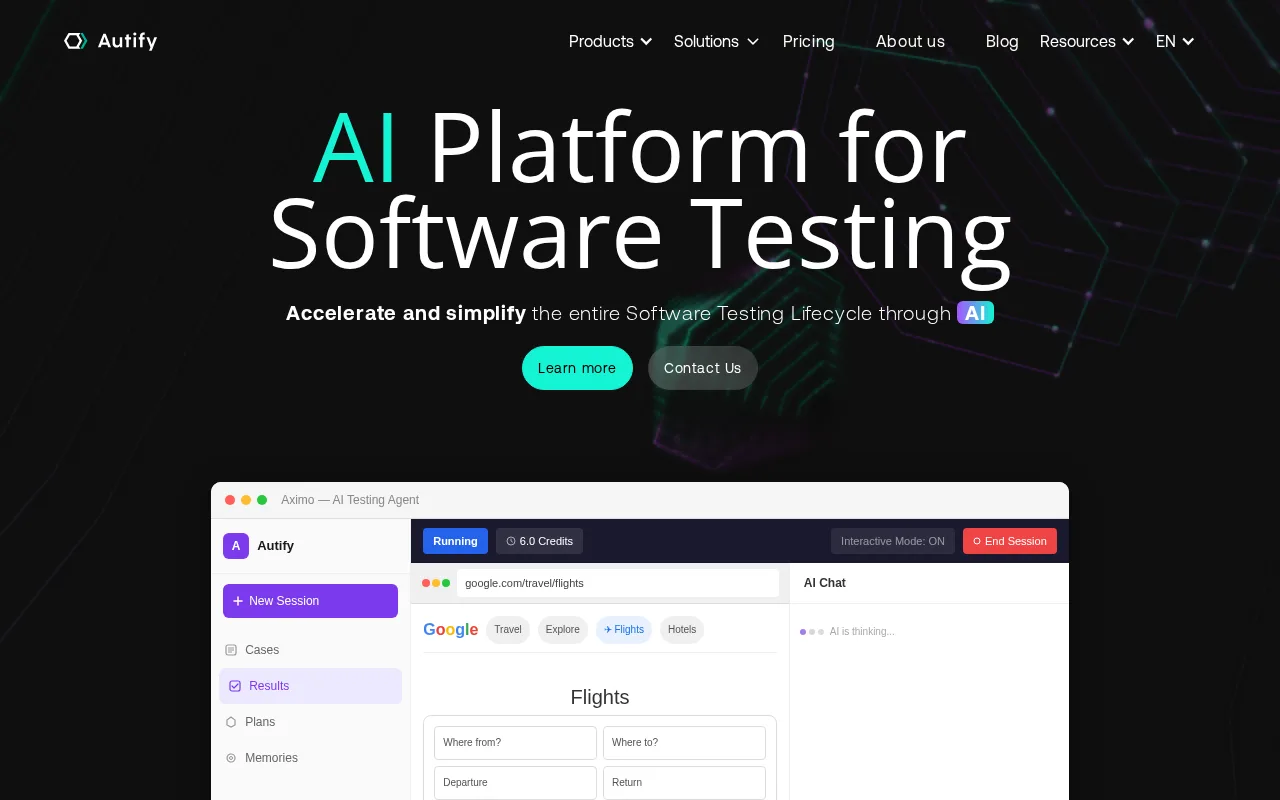
- No-code Test Creation — Record browser actions to create automated tests without coding.
- Self-healing AI — Automatically adapts tests to UI changes, reducing maintenance.
- Cross-browser testing — Run tests on Chrome, Firefox, Edge, and Safari.
- Mobile Web Testing — Test web apps on mobile browsers and devices.
- Parallel Test Execution — Run multiple tests simultaneously in the cloud.
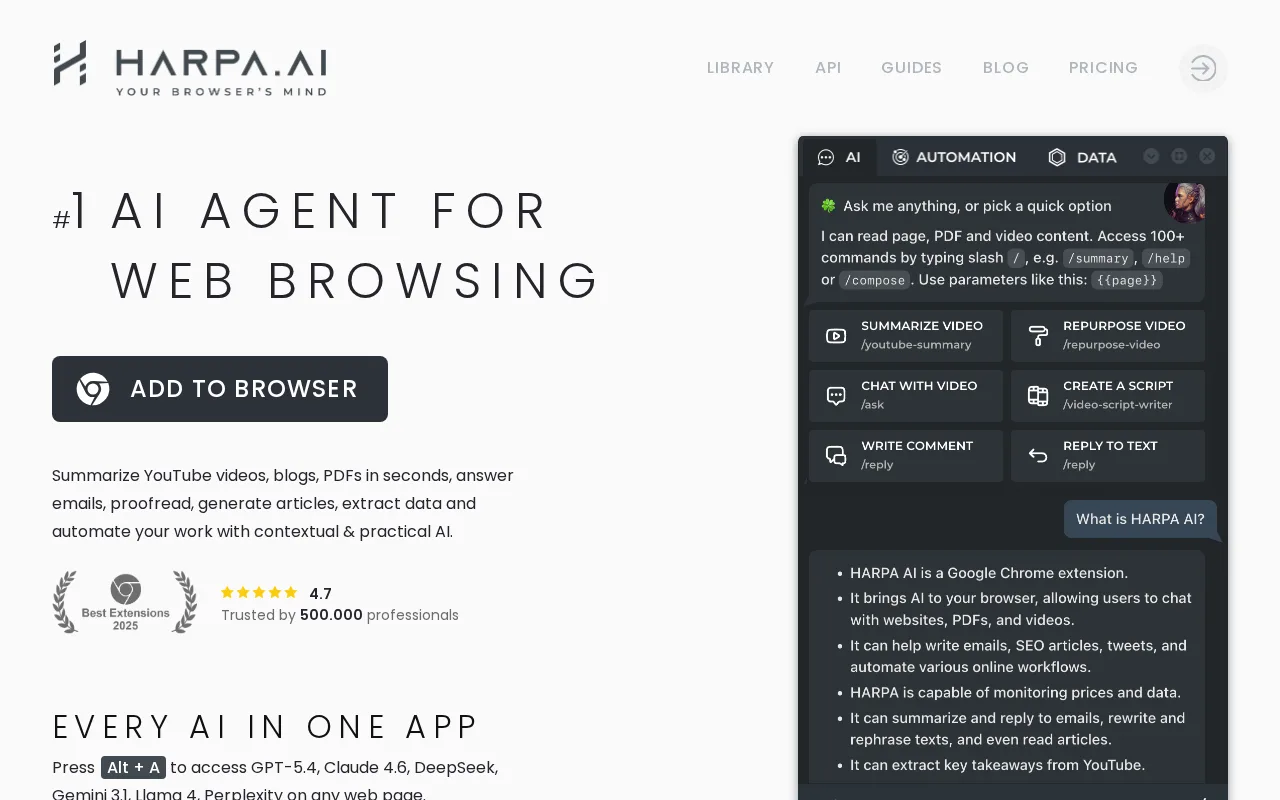
- Task Automation — Automate repetitive browser tasks with AI prompts
- Data Extraction — Extract structured data directly from web pages
- Text Summarization — Summarize web page content using AI
- Browser Integration — Runs as a browser extension for Chrome-based browsers
- Custom AI Prompts — Create page-aware AI prompts for tailored automation
- No-code test creation enables non-technical users to automate testing.
- Self-healing AI reduces test maintenance when UI changes occur.
- Supports cross-browser and mobile web testing.
- Cloud-based execution scales without local setup.
- Intuitive interface and detailed reporting.
- Combines AI prompts with browser automation effectively
- Simplifies complex web data extraction
- Enhances productivity for marketers and knowledge workers
- Accessible freemium model
- No coding required for basic automation
- Pricing is not fully transparent and may be high for startups or small teams.
- Limited advanced scripting and customization compared to code-based frameworks.
- No public API for deep integration with custom CI/CD pipelines.
- Limited to browser extension usage
- Advanced features behind paid plans
- No public API available
- Automating regression testing for web applications
- Cross-browser compatibility testing
- Mobile web application testing
- Continuous integration test automation
- Reducing manual QA workload
- Automate data scraping from websites
- Summarize lengthy web articles quickly
- Extract financial data for analysis
- Streamline marketing research workflows
- Automate form filling and repetitive browsing tasks
Where each tool runs — web, mobile, desktop, browser extension, API.
No platforms confirmed.
Natural languages each tool generates and understands. Primary languages are listed first.
What each tool can accept (input) and produce (output) — text, image, audio, video, code.
Autify offers a free trial and custom pricing for paid plans based on usage and features. Pricing details are not fully public; users must contact sales for enterprise or advanced tiers.
-
Free Trial
Free · 14-day trial -
Standard
popular
Custom pricing -
Enterprise
Custom pricing
Offers a free plan with basic features and paid subscriptions for advanced automation and higher usage limits.
-
Free
Free
Regulatory frameworks each tool claims compliance with (HIPAA, SOC 2, GDPR, etc.).
None listed.
Vendor-published numbers each tool highlights — usage scale, breadth, and operational stats. Different tools track different metrics, so direct row-by-row comparison usually isn't meaningful.
- Test maintenance reduction Up to 80%
- Supported browsers 4+
- Tasks automated per day Varies by user
Who each tool is positioned for — primary audience first.
No specific audience listed.
How you can reach support — email, live chat, phone, community, docs.
- Email primary
- Documentation
- Documentation primary
How each tool is classified in the Volvenix catalog.
These vocabulary domains are managed in our catalog but not yet exposed at the tool level. We're tracking them for future expansion of this comparison.
- Encryption Types — AES-256, ChaCha20, RSA-2048, and similar at-rest/in-transit cipher families.
- Encryption Contexts — where encryption is applied (data at rest, in transit, end-to-end).
- Plan-tier Model Mapping — which AI models are available on which pricing tier (currently only the model list is tracked, not the per-plan availability).
- What is this tool?
- Autify is a no-code, cloud-based platform for automating end-to-end browser testing of web applications.
- How much does it cost?
- Pricing is not fully public; Autify offers a free trial and custom pricing for paid plans.
- Does it have a free plan?
- Autify offers a free trial but does not have an ongoing free plan.
- What integrations does it support?
- Autify integrates with Slack, Jira, and CI/CD tools like CircleCI and GitHub Actions.
- Who is it best for?
- Best for QA teams, developers, and product managers seeking scalable, low-code browser test automation.
- What is this tool?
- HARPA is a browser extension that automates tasks and extracts data from web pages using AI.
- How much does it cost?
- HARPA offers a free plan with basic features and paid subscriptions for advanced automation.
- Does it have a free plan?
- Yes, HARPA provides a free plan suitable for individual users with limited automation needs.
- What integrations does it support?
- HARPA primarily integrates as a browser extension and does not list third-party SaaS integrations.
- Who is it best for?
- It is best for marketers and knowledge workers who need to automate browser tasks and extract web data.
| Info | Autify | HARPA |
|---|---|---|
| Pricing | Freemium | Freemium |
| Category | AI Agents & Automation | AI Agents & Automation |
| Deployment | Cloud | Browser extension |
| Learning Curve | — | Intermediate |
| Free Plan | ✗ | ✓ |
| AI Agent | ✓ | ✓ |
| Autonomy | Assistant | Assistant |
| Risk Tier | Medium | Medium |
| BYO API Key | ✗ | — |
| Local Models | ✗ | — |
| Fine-tuning | ✗ | — |
 Applitools
 AgentGPT
 Functionize
 Polyaxon
 Testim
 AutoLogicX
 Superblocks
 Hypatos
HARPA and Autify both offer freemium pricing models, allowing users to access basic features at no cost. HARPA has an overall score of 5.2/10 and is primarily focused on web automation and data extraction tasks, catering to users needing customizable browser-based workflows. Autify, with a slightly higher overall score of 5.8/10, emphasizes automated testing for web and mobile applications, targeting quality assurance teams seeking to streamline test creation and execution without extensive coding.
ⓘ How Volvenix scores work
Scores are computed by Volvenix — not supplied by the vendors, and not third-party benchmark results. Each 0–10 dimension (Overall, Features, Usability, Support, Pricing) is a directional estimate aggregated from catalog signals — editorial cataloguing, content depth, engagement, and provider-reputation indicators — so treat them as a starting point, not a lab result.
Confidence reflects how complete the underlying data is for both tools; lower confidence means fewer signals were available, not a worse tool. We never accept payment for rankings or scores. More about how Volvenix works →