 Volvenix
Applitools vs Functionize
AI-enhanced independent comparison — features, pros, cons, pricing and rankings.
 ChatGPT
  Claude
  Gemini
  Midjourney
  DALL-E
  Stable Diffusion
  Notion AI
  Canva
Canva  Grammarly
  GitHub Copilot
  ElevenLabs
  Perplexity
  Runway
  Synthesia
  Fireflies.ai
  Hugging Face Hub

| Dimension | Applitools | Functionize |
|---|---|---|
| Accuracy & Reliability | ||
| Ease of Use | ||
| Features & Capability | ||
| Value for Money | ||
| Performance & Speed | ||
| Popularity & Adoption |
Who each tool serves best — and when to pick the other one.
Development and QA teams at software companies who need to ensure pixel-perfect UI across browsers and devices.
- You need to catch subtle UI regressions across multiple browsers and devices automatically.
- You want seamless integration with your existing test automation and CI/CD pipelines.
- Your team requires scalable, parallelized visual testing for complex web or mobile apps.
Solo developers, hobbyists, or teams with minimal UI testing needs, or those requiring a fully open-source solution.
- You need a fully open-source visual testing solution with no vendor lock-in.
- Free-tier limits are a blocker for your high-volume or enterprise-scale testing needs.
- You require advanced API access or custom integrations not supported by the platform.
The accuracy and scalability of its Visual AI engine for cross-browser UI regression detection.
QA teams and developers at SMBs or enterprises who need scalable, low-maintenance browser test automation.
- You need to automate end-to-end browser tests for complex web applications at scale.
- You want to reduce test maintenance with self-healing and NLP-powered test creation.
- Your team requires a cloud-based platform for collaborative test management and execution.
Solo developers or teams needing open-source, on-premise, or highly customizable frameworks.
- You need a fully open-source or on-premise solution for strict data control or customization.
- Free-tier limits are a blocker for large-scale or enterprise-grade testing requirements.
- You require deep API integrations or public API access for custom workflows.
Ability to automate and maintain complex browser tests with minimal manual intervention.
A canonical comparison across capabilities common to this category. Vendor-specific extras appear below in "Highlighted Features".
| Capability | Applitools | Functionize |
|---|---|---|
|
Free Tier Available
Usable without payment (with usage limits)
|
✓ | ✓ |
|
Free Trial
Time-limited paid-plan trial
|
— | ✓ |
| Feature | Applitools | Functionize |
|---|---|---|
| Parallel Test Execution | Run multiple tests simultaneously | Run multiple tests simultaneously |
Each tool's marketing-listed features. Where a feature appears under one tool but not the other, it usually reflects how the vendor describes their product — not a definitive capability gap.
- Visual AI engine — Detects visual differences across browsers and devices
- Cross-browser testing — Runs tests on multiple browsers and devices
- CI/CD Integration — Works with Jenkins, GitHub Actions, and more
- Detailed visual reports — Provides side-by-side visual diffs and logs
- Natural Language Test Creation — Create tests using plain English instructions
- Self-healing tests — Automatically adapts tests to UI changes
- Cloud-based execution — Run tests at scale in the cloud
- Test Management Dashboard — Centralized dashboard for test management
- Accurate visual regression detection
- Integrates with major test frameworks
- Supports web and mobile platforms
- Parallel test execution
- Detailed visual difference reports
- Natural language test creation reduces scripting effort
- Self-healing tests adapt to UI changes automatically
- Cloud-based platform enables easy scaling and collaboration
- Handles complex web applications effectively
- Reduces manual maintenance for QA teams
- Free plan has limited test runs per month
- Pricing for large teams or enterprise can be high
- No public API for custom integrations
- No open-source or on-premise deployment options
- No public API for custom integrations
- Pricing details are not fully transparent online
- Automated UI regression testing
- Cross-browser compatibility checks
- Mobile app visual validation
- Continuous integration visual QA
- Pixel-perfect design verification
- Automating regression testing for web applications
- Reducing manual QA workload with self-healing tests
- Scaling browser-based test suites for enterprise apps
- Collaborative test management for distributed QA teams
- Testing complex, dynamic web UIs with minimal scripting
Natural languages each tool generates and understands. Primary languages are listed first.
What each tool can accept (input) and produce (output) — text, image, audio, video, code.
Applitools offers a free plan with limited usage, and paid plans for professional and team needs. Pricing increases with test volume and advanced features.
-
Free
Free -
Pro
popular
Custom pricing -
Team
Custom pricing
Functionize offers a free plan with limited features and usage. Paid plans with advanced capabilities and higher usage limits are available; pricing details require contacting sales.
-
Free
Free -
Pro
popular
Custom pricing · 14-day trial -
Enterprise
Custom pricing · 14-day trial
Regulatory frameworks each tool claims compliance with (HIPAA, SOC 2, GDPR, etc.).
Vendor-published numbers each tool highlights — usage scale, breadth, and operational stats. Different tools track different metrics, so direct row-by-row comparison usually isn't meaningful.
- Browsers supported 50+
- Parallel test runs Unlimited (paid)
- Test maintenance reduction Up to 80%
- Parallel test execution Yes
How each tool is classified in the Volvenix catalog.
These vocabulary domains are managed in our catalog but not yet exposed at the tool level. We're tracking them for future expansion of this comparison.
- Encryption Types — AES-256, ChaCha20, RSA-2048, and similar at-rest/in-transit cipher families.
- Encryption Contexts — where encryption is applied (data at rest, in transit, end-to-end).
- Plan-tier Model Mapping — which AI models are available on which pricing tier (currently only the model list is tracked, not the per-plan availability).
- What is this tool?
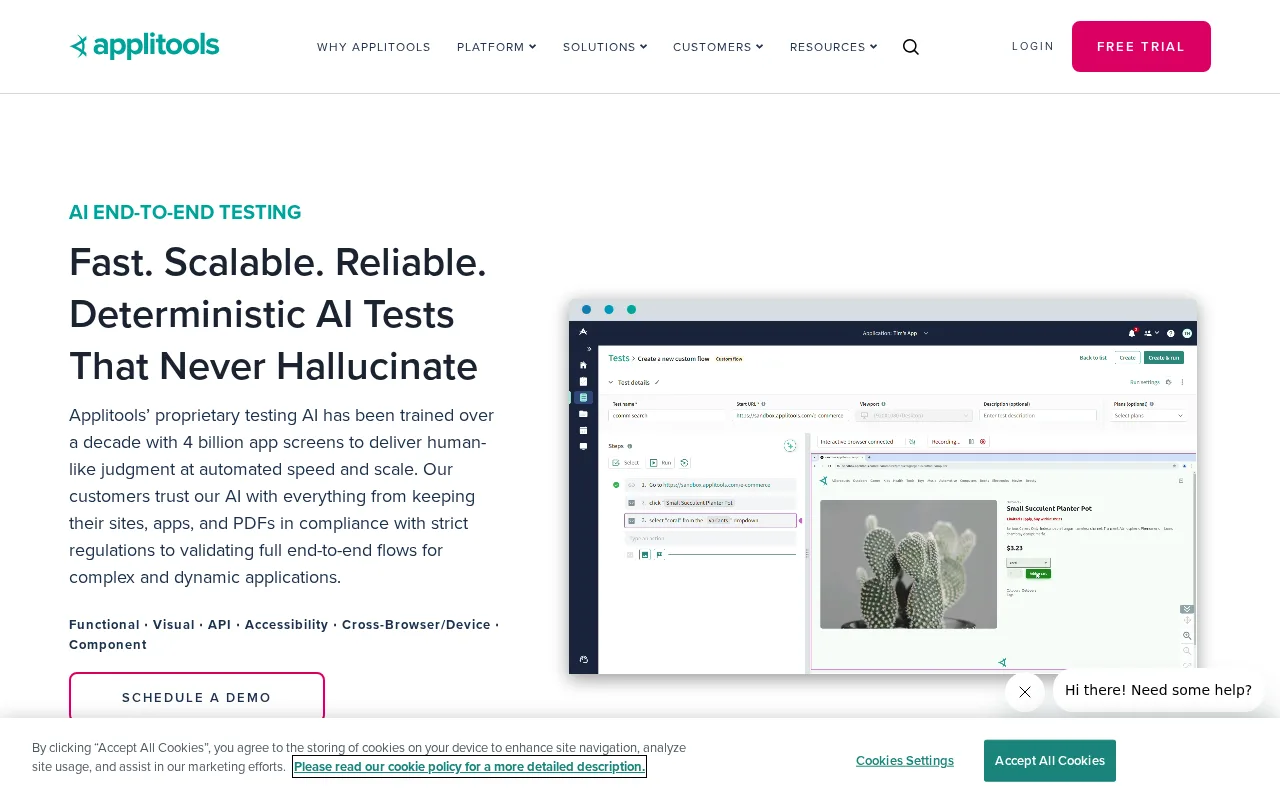
- Applitools automates visual testing for web and mobile apps, detecting UI differences across browsers and devices.
- How much does it cost?
- Applitools offers a free plan with limited usage; paid plans are available for higher test volumes and advanced features.
- Does it have a free plan?
- Yes, Applitools provides a free plan with limited test runs per month.
- What integrations does it support?
- It integrates with popular test frameworks like Selenium, Cypress, Playwright, and CI/CD tools such as Jenkins and GitHub Actions.
- Who is it best for?
- Best for development and QA teams needing reliable, automated visual regression testing across browsers and devices.
- What is this tool?
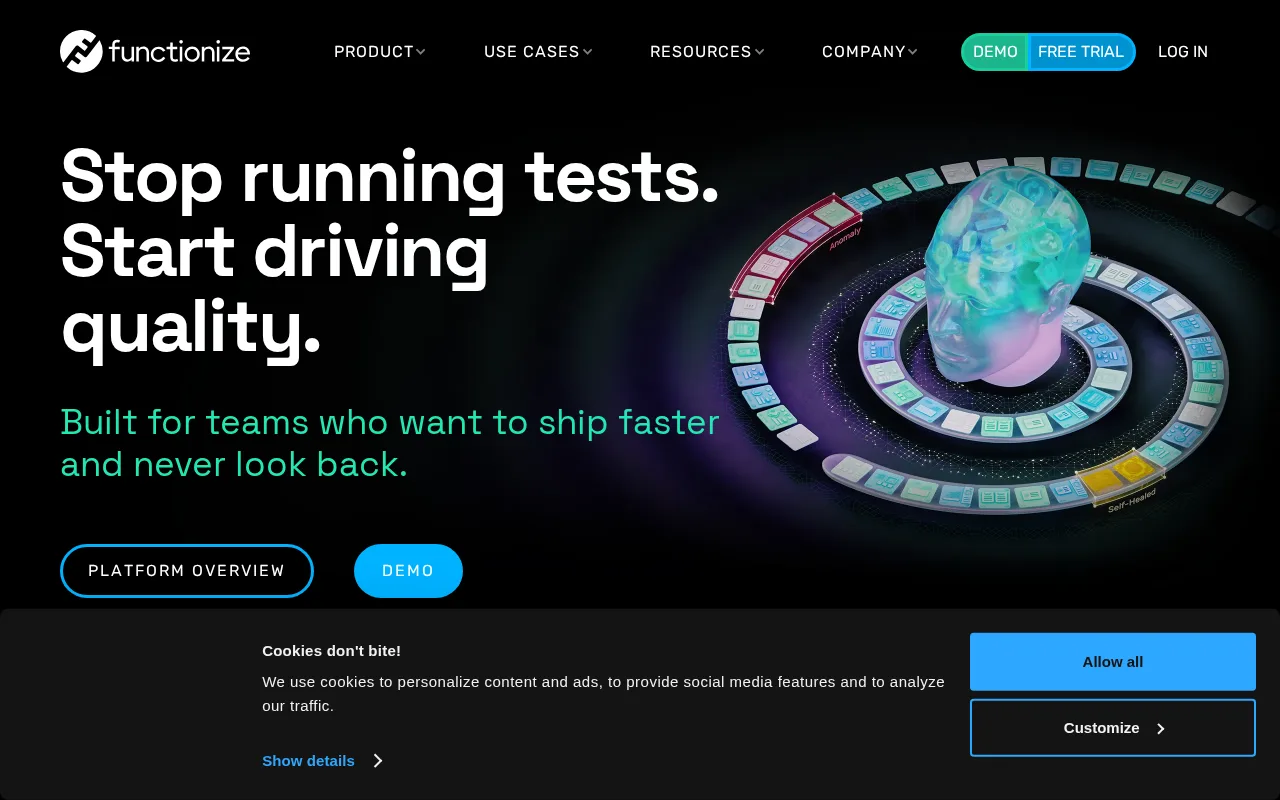
- Functionize is a cloud-based platform for automating browser-based web testing using natural language and self-healing technology.
- How much does it cost?
- Functionize offers a free plan with limited features; paid plans require contacting sales for pricing.
- Does it have a free plan?
- Yes, Functionize provides a free plan with limited test runs and features.
- What integrations does it support?
- Functionize supports select integrations such as Jira and Slack for test management and notifications.
- Who is it best for?
- Functionize is best for QA teams and developers needing scalable, low-maintenance browser test automation.
| Info | Applitools | Functionize |
|---|---|---|
| Pricing | Freemium | Freemium |
| Category | AI Agents & Automation | AI Agents & Automation |
| Deployment | Cloud | Cloud |
| Free Plan | ✓ | ✓ |
| AI Agent | ✓ | ✓ |
| Autonomy | Assistant | Assistant |
| Risk Tier | Medium | Medium |
| BYO API Key | ✗ | — |
| Local Models | ✗ | — |
| Fine-tuning | ✗ | — |
 SuperAGI
 Autify
 MultiOn
 Superblocks
 Polyaxon
 Browser Harness
 Cloudera Machine Learning
Applitools has an overall score of 5.8/10 and offers a freemium pricing model, focusing primarily on visual AI testing and cross-browser compatibility for UI validation. Functionize, with a slightly lower overall score of 5.5/10 and also a freemium pricing model, emphasizes AI-driven test automation with capabilities for natural language test creation and cloud-based execution. While Applitools is widely used for visual regression testing, Functionize targets broader end-to-end test automation with an emphasis on ease of test design and maintenance.
ⓘ How Volvenix scores work
Scores are computed by Volvenix — not supplied by the vendors, and not third-party benchmark results. Each 0–10 dimension (Overall, Features, Usability, Support, Pricing) is a directional estimate aggregated from catalog signals — editorial cataloguing, content depth, engagement, and provider-reputation indicators — so treat them as a starting point, not a lab result.
Confidence reflects how complete the underlying data is for both tools; lower confidence means fewer signals were available, not a worse tool. We never accept payment for rankings or scores. More about how Volvenix works →