 Volvenix
TinEye vs Truepic
AI-enhanced independent comparison — features, pros, cons, pricing and rankings.
 ChatGPT
  Claude
  Gemini
  Midjourney
  DALL-E
  Stable Diffusion
  Notion AI
  Canva
Canva  Grammarly
  GitHub Copilot
  ElevenLabs
  Perplexity
  Runway
  Synthesia
  Fireflies.ai
  Hugging Face Hub

| Dimension | TinEye | Truepic |
|---|---|---|
| Accuracy & Reliability | ||
| Ease of Use | ||
| Features & Capability | ||
| Value for Money | ||
| Performance & Speed | ||
| Popularity & Adoption |
Who each tool serves best — and when to pick the other one.
Journalists, photographers, and brand protection teams needing precise image origin verification and copyright tracking.
- You need to verify the origin and usage of specific images online accurately.
- You want to protect your brand or creative work from unauthorized image reuse.
- Your team requires a dedicated tool for reverse image search and copyright tracking.
Casual users or those seeking free unlimited image searches; users needing AI-enhanced image analysis.
- You need unlimited free image searches without usage limits or costs.
- Free-tier limits are a blocker for your frequent or bulk image search needs.
- You require AI-powered image analysis beyond reverse image search.
Accuracy and reliability of reverse image search results for copyright and origin tracking.
Compliance teams, insurers, and media organizations needing verifiable, tamper-proof digital images.
- You need to ensure submitted images are authentic and have not been manipulated post-capture.
- You want a solution that embeds tamper-evident metadata directly into digital photos.
- Your team requires visual content verification for compliance, fraud prevention, or claims processing.
Developers or teams seeking open APIs, extensive integrations, or customizable workflows.
- You need a public API or developer access for custom integrations and automation.
- Free-tier limits are a blocker for large-scale or high-volume image verification needs.
- You require support for video, document, or non-image media authenticity verification.
The ability to guarantee image authenticity at the point of capture.
A canonical comparison across capabilities common to this category. Vendor-specific extras appear below in "Highlighted Features".
| Capability | TinEye | Truepic |
|---|---|---|
|
API Access
Programmatic access via documented API
|
✓ | — |
|
Free Tier Available
Usable without payment (with usage limits)
|
— | ✓ |
Each tool's marketing-listed features. Where a feature appears under one tool but not the other, it usually reflects how the vendor describes their product — not a definitive capability gap.
- Reverse image search — Locate where images appear online
- Image Origin Verification — Verify image sources and authenticity
- Copyright Tracking — Track unauthorized image reuse
- Browser Extension — Search images directly from browser
- Tamper-evident image capture — Captures images with embedded, secure metadata at the point of origin
- Manipulation detection — Detects post-capture image alterations or edits
- Metadata verification — Verifies time, location, and device data for each image
- Compliance Reporting — Generates reports for audit and compliance needs
- Custom Branding — Add organization branding to verification reports
- Accurate and reliable reverse image search
- Effective for copyright and brand protection
- Easy to use with a clean interface
- Large indexed image database
- Verifies image authenticity at capture
- Tamper-evident metadata for trust
- Widely used in compliance-heavy industries
- Detects manipulation and alteration attempts
- Simple cloud-based deployment
- No free unlimited usage or free tier
- Lacks advanced AI-powered image analysis features
- No public API for developer access
- Limited integration options with third-party platforms
- Focuses only on images, not video or documents
- Verify image authenticity for journalism
- Protect brand images from unauthorized use
- Track image reuse across websites
- Detect copyright infringement
- Find higher resolution versions of images
- Insurance claim verification
- Media content authentication
- Compliance documentation
- Fraud prevention in remote onboarding
- Supply chain visual audits
No third-party integrations confirmed.
Where each tool runs — web, mobile, desktop, browser extension, API.
No platforms confirmed.
Natural languages each tool generates and understands. Primary languages are listed first.
What each tool can accept (input) and produce (output) — text, image, audio, video, code.
Pricing is based on paid plans with credits for image searches; no free unlimited tier is available.
-
Free
Free -
Pro
popular
$20.00/mo -
Team
$30.00/mo
Truepic offers a free plan with limited features and paid tiers for organizations with higher usage or advanced needs. Pricing details are available upon request.
-
Free
Free -
Pro
popular
Custom pricing -
Enterprise
Custom pricing
Regulatory frameworks each tool claims compliance with (HIPAA, SOC 2, GDPR, etc.).
Vendor-published numbers each tool highlights — usage scale, breadth, and operational stats. Different tools track different metrics, so direct row-by-row comparison usually isn't meaningful.
- Image Matches Found Millions
- Verified images per month Varies by plan
- Tamper detection accuracy High
How you can reach support — email, live chat, phone, community, docs.
- Email primary
- Email primary
How each tool is classified in the Volvenix catalog.
These vocabulary domains are managed in our catalog but not yet exposed at the tool level. We're tracking them for future expansion of this comparison.
- Encryption Types — AES-256, ChaCha20, RSA-2048, and similar at-rest/in-transit cipher families.
- Encryption Contexts — where encryption is applied (data at rest, in transit, end-to-end).
- Plan-tier Model Mapping — which AI models are available on which pricing tier (currently only the model list is tracked, not the per-plan availability).
- What is this tool?
- TinEye is a reverse image search engine that helps find where images appear online.
- How much does it cost?
- TinEye offers paid plans based on image search credits; no free unlimited plan is available.
- Does it have a free plan?
- TinEye does not offer a free unlimited plan but may provide limited free searches.
- What integrations does it support?
- TinEye offers a browser extension and paid API access for integration.
- Who is it best for?
- It is best for journalists, photographers, and brand protection teams needing image origin verification.
- What is this tool?
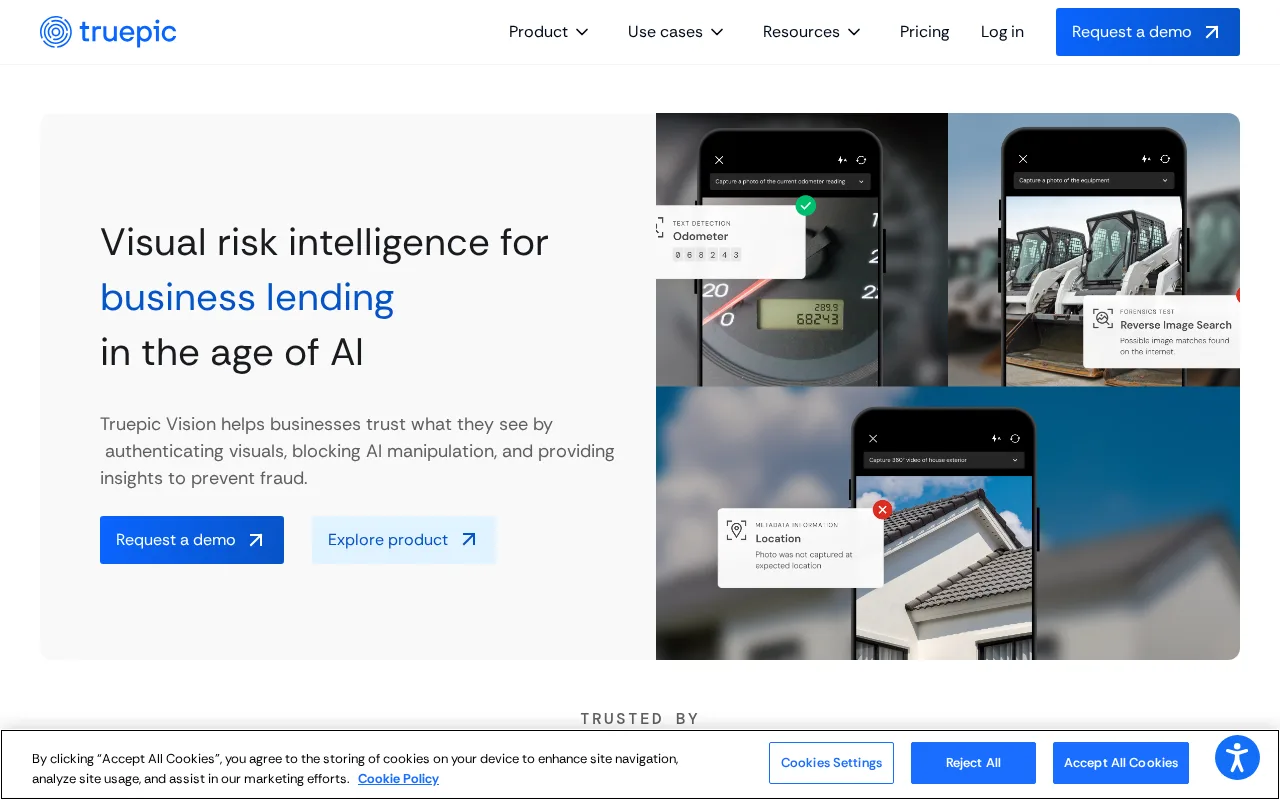
- Truepic is a platform for verifying the authenticity of digital images using secure metadata and tamper detection.
- How much does it cost?
- Truepic offers a free plan with limited usage and paid plans for organizations; pricing is available upon request.
- Does it have a free plan?
- Yes, Truepic provides a free plan with limited features and usage.
- What integrations does it support?
- Truepic does not list public integrations; custom integrations may be available for enterprise clients.
- Who is it best for?
- It is best for organizations needing to verify image authenticity for compliance, insurance, or fraud prevention.
| Info | TinEye | Truepic |
|---|---|---|
| Pricing | Paid | Freemium |
| Category | Computer Vision & Image Recognition | Computer Vision & Image Recognition |
| Deployment | Cloud | Cloud |
| Learning Curve | Beginner | — |
| Free Plan | ✗ | ✓ |
| AI Agent | ✓ | ✗ |
| Autonomy | Assistant | Assistant |
| Risk Tier | Low | Medium |
 Bing Visual Search
 Audible Magic Content ID
 Lenso AI
 Reversely.ai
TinEye has an overall score of 5.4/10 and operates on a paid pricing model, primarily focusing on reverse image search and image verification for copyright enforcement and content tracking. Truepic, with an overall score of 5.2/10, offers a freemium pricing structure and emphasizes image and video authentication for verifying visual content integrity, often used in journalism and insurance claims. While TinEye specializes in identifying image origins and duplicates, Truepic centers on ensuring the authenticity of captured media.
ⓘ How Volvenix scores work
Scores are computed by Volvenix — not supplied by the vendors, and not third-party benchmark results. Each 0–10 dimension (Overall, Features, Usability, Support, Pricing) is a directional estimate aggregated from catalog signals — editorial cataloguing, content depth, engagement, and provider-reputation indicators — so treat them as a starting point, not a lab result.
Confidence reflects how complete the underlying data is for both tools; lower confidence means fewer signals were available, not a worse tool. We never accept payment for rankings or scores. More about how Volvenix works →