 Volvenix
Tamr vs TransmogrifAI
AI-enhanced independent comparison — features, pros, cons, pricing and rankings.
 ChatGPT
  Claude
  Gemini
  Midjourney
  DALL-E
  Stable Diffusion
  Notion AI
  Canva
Canva  Grammarly
  GitHub Copilot
  ElevenLabs
  Perplexity
  Runway
  Synthesia
  Fireflies.ai
  Hugging Face Hub

| Dimension | Tamr | TransmogrifAI |
|---|---|---|
| Accuracy & Reliability | — | |
| Ease of Use | — | |
| Features & Capability | — | |
| Value for Money | — | |
| Performance & Speed | — | |
| Popularity & Adoption | — |
Who each tool serves best — and when to pick the other one.
Enterprise data teams in healthcare, finance, or life sciences needing scalable, automated data unification and enrichment.
- You need to unify large, complex datasets from multiple sources efficiently.
- You want to reduce manual data cleaning with machine learning-assisted workflows.
- Your team requires scalable data integration for regulated industries like healthcare or finance.
Small businesses or teams without complex data integration needs or limited data engineering resources.
- You need a simple, out-of-the-box data integration tool for small datasets.
- Free-tier limits are a blocker for your evaluation or pilot projects.
- You require extensive native integrations with common SaaS apps not documented by Tamr.
Ability to automate and scale complex data unification across disparate enterprise sources.
Data scientists and ML engineers working with big data on Apache Spark who want to automate feature engineering and pipeline building.
- You work with large-scale datasets on Apache Spark clusters regularly.
- You want to automate complex feature engineering and ML pipeline construction.
- Your team has Scala and Spark expertise to customize and extend pipelines.
Users without Spark expertise or those seeking a fully managed AutoML SaaS with minimal setup and GUI-driven workflows.
- You need a no-code or low-code AutoML solution with graphical interfaces.
- Free-tier limits are a blocker for your production needs (not applicable here).
- You require commercial support or managed cloud AutoML services.
Integration with Apache Spark for scalable automated feature engineering.
A canonical comparison across capabilities common to this category. Vendor-specific extras appear below in "Highlighted Features".
| Capability | Tamr | TransmogrifAI |
|---|---|---|
|
Free Tier Available
Usable without payment (with usage limits)
|
✓ | ✓ |
Each tool's marketing-listed features. Where a feature appears under one tool but not the other, it usually reflects how the vendor describes their product — not a definitive capability gap.
- Data unification — Automates combining disparate datasets
- Duplicate Resolution — Efficiently identifies and merges duplicates
- Machine Learning Integration — Uses ML to improve data matching accuracy
- Human-in-the-loop Feedback — Allows expert input to refine results
- Enterprise Data Enrichment — Enhances datasets with additional context
- Automated Feature Engineering — Automatically generates and selects features from raw data
- Model Training Pipelines — Builds end-to-end ML pipelines including training and validation
- Apache Spark Integration — Runs natively on Spark for distributed processing
- Custom Feature Engineering — Allows user-defined feature transformations
- Model Selection and Tuning — Supports automated model selection and hyperparameter tuning
- Automates complex data unification at scale
- Integrates machine learning with human feedback
- Designed for regulated industries
- Efficient duplicate detection and resolution
- Enterprise-grade data enrichment capabilities
- Automates complex feature engineering workflows
- Scales efficiently on Apache Spark clusters
- Open-source with active community contributions
- Facilitates enterprise-grade ML pipeline automation
- Reduces manual coding for feature extraction
- Limited public pricing transparency
- Not suitable for small or simple data projects
- No publicly documented API
- Requires strong Apache Spark and Scala knowledge
- No commercial support or managed cloud offering
- Enterprise data unification
- Healthcare data integration
- Financial data enrichment
- Life sciences dataset consolidation
- Duplicate record resolution
- Enterprise-scale machine learning pipelines
- Automated feature engineering on big data
- Model training and validation on Spark clusters
- Reducing manual ML pipeline development effort
- Custom feature extraction for complex datasets
Where each tool runs — web, mobile, desktop, browser extension, API.
The underlying AI models each tool runs on. Model details show on hover.
No models confirmed.
Natural languages each tool generates and understands. Primary languages are listed first.
What each tool can accept (input) and produce (output) — text, image, audio, video, code.
Tamr offers a freemium pricing model with limited free access and paid tiers for enterprise features; detailed pricing requires contacting sales.
-
Free
Free
TransmogrifAI is completely free and open-source with no paid tiers or subscriptions.
-
Free
Free
Regulatory frameworks each tool claims compliance with (HIPAA, SOC 2, GDPR, etc.).
None listed.
Third-party audits and certifications that verify security controls.
No certifications listed.
Vendor-published numbers each tool highlights — usage scale, breadth, and operational stats. Different tools track different metrics, so direct row-by-row comparison usually isn't meaningful.
- User Satisfaction 85%
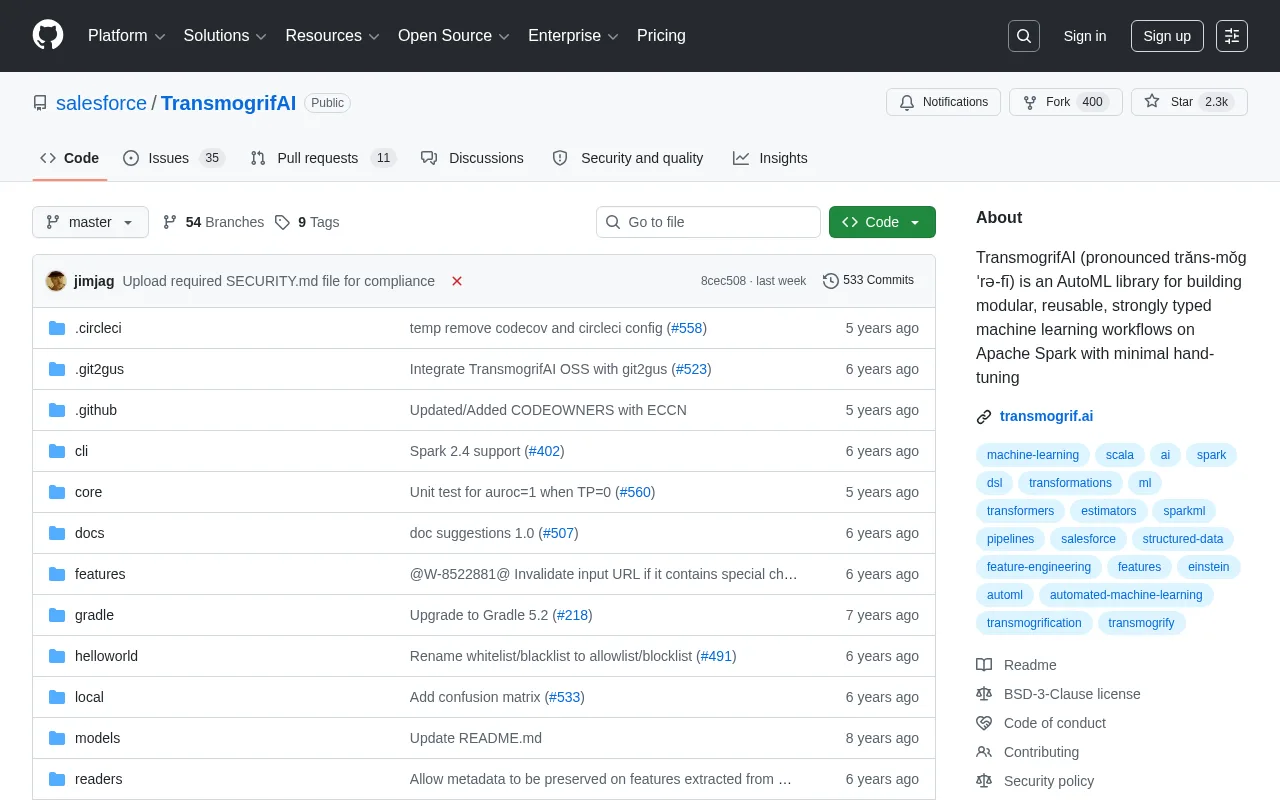
- GitHub Stars 2.7k+
- Contributors 60+
Who each tool is positioned for — primary audience first.
How you can reach support — email, live chat, phone, community, docs.
- Documentation primary
- Documentation primary visit ↗
How each tool is classified in the Volvenix catalog.
These vocabulary domains are managed in our catalog but not yet exposed at the tool level. We're tracking them for future expansion of this comparison.
- Encryption Types — AES-256, ChaCha20, RSA-2048, and similar at-rest/in-transit cipher families.
- Encryption Contexts — where encryption is applied (data at rest, in transit, end-to-end).
- Plan-tier Model Mapping — which AI models are available on which pricing tier (currently only the model list is tracked, not the per-plan availability).

- What is this tool?
- Tamr automates the unification and enrichment of complex enterprise datasets across multiple sources.
- How much does it cost?
- Tamr offers a freemium model with limited free access; detailed pricing requires contacting sales.
- Does it have a free plan?
- Yes, Tamr provides a free plan with limited features for evaluation purposes.
- What integrations does it support?
- Tamr connects to various enterprise data sources but does not publicly list specific SaaS integrations.
- Who is it best for?
- It is best suited for enterprise data teams in healthcare, finance, and life sciences needing scalable data unification.
- What is this tool?
- TransmogrifAI is an open-source AutoML library that automates feature engineering and model training on Apache Spark.
- How much does it cost?
- TransmogrifAI is completely free and open-source with no licensing fees.
- Does it have a free plan?
- Yes, the entire tool is free and open-source.
- What integrations does it support?
- It integrates natively with Apache Spark for distributed data processing.
- Who is it best for?
- Data scientists and engineers working with large datasets on Spark who want automated feature engineering.
Tamr Data Mastering
—
| Info | Tamr | TransmogrifAI |
|---|---|---|
| Pricing | Freemium | Free |
| Launch Year | 2023 | — |
| Category | Data Engineering, MLOps & Pipelines | Data Engineering, MLOps & Pipelines |
| Deployment | Cloud | Self-hosted |
| Learning Curve | Advanced | Advanced |
| Free Plan | ✓ | ✓ |
| AI Agent | ✓ | ✗ |
| Autonomy | Copilot | Copilot |
| Risk Tier | Medium | Low |
| BYO API Key | ✗ | — |
| Local Models | ✗ | — |
| Fine-tuning | ✗ | — |
 Dataiku
 Flatfile
 Hopsworks
 Kaskada
 Metaplane
 Azure Machine Learning
 DNAnexus Platform
 Flyte
FlyteTransmogrifAI has an overall score of 5.4/10 and is offered for free, focusing primarily on automated machine learning for structured data. Tamr scores 6.2/10 and uses a freemium pricing model, emphasizing data unification and mastering across large, complex datasets. While TransmogrifAI is suited for streamlined ML model development, Tamr targets enterprises needing scalable data integration and curation solutions.
ⓘ How Volvenix scores work
Scores are computed by Volvenix — not supplied by the vendors, and not third-party benchmark results. Each 0–10 dimension (Overall, Features, Usability, Support, Pricing) is a directional estimate aggregated from catalog signals — editorial cataloguing, content depth, engagement, and provider-reputation indicators — so treat them as a starting point, not a lab result.
Confidence reflects how complete the underlying data is for both tools; lower confidence means fewer signals were available, not a worse tool. We never accept payment for rankings or scores. More about how Volvenix works →