 Volvenix
Photomath vs Cognii Virtual Learning Assistant
AI-enhanced independent comparison — features, pros, cons, pricing and rankings.
 ChatGPT
  Claude
  Gemini
  Midjourney
  DALL-E
  Stable Diffusion
  Notion AI
  Canva
Canva  Grammarly
  GitHub Copilot
  ElevenLabs
  Perplexity
  Runway
  Synthesia
  Fireflies.ai
  Hugging Face Hub
 | Dimension | Photomath | Cognii Virtual Learning Assistant |
|---|---|---|
| Accuracy & Reliability | ||
| Ease of Use | ||
| Features & Capability | ||
| Value for Money | ||
| Performance & Speed | ||
| Popularity & Adoption |
Who each tool serves best — and when to pick the other one.
Students and learners who want instant, detailed math problem solutions and step-by-step explanations.
- You want quick solutions to math problems using your phone camera
- You need detailed step-by-step explanations for homework help
- You prefer a mobile app for on-the-go math practice and learning
Users needing collaborative math tools or advanced symbolic computation beyond camera scanning.
- You require collaborative math problem solving features
- Free-tier limits prevent you from solving many problems daily
- You need advanced math software for symbolic or programming tasks
Accuracy and clarity of step-by-step math problem solutions from camera input.
Educators and institutions needing automated grading for open-response assessments and instant student feedback.
- You want to automate grading of essays and short answers to save educator time
- You need instant, personalized feedback for students on open-response questions
- Your institution focuses on formative assessment beyond multiple-choice tests
Users requiring extensive third-party integrations, API access, or automated grading for multiple-choice only tests.
- You need extensive API access or custom integrations for your LMS
- Free-tier limits are a blocker for your institution’s scale or usage needs
- You require automated grading primarily for multiple-choice or objective tests
Effectiveness in automating grading and feedback for open-ended educational assessments.
A canonical comparison across capabilities common to this category. Vendor-specific extras appear below in "Highlighted Features".
| Capability | Photomath | Cognii Virtual Learning Assistant |
|---|---|---|
|
Free Tier Available
Usable without payment (with usage limits)
|
✓ | ✓ |
Each tool's marketing-listed features. Where a feature appears under one tool but not the other, it usually reflects how the vendor describes their product — not a definitive capability gap.
- Math Problem Scanning — Scan math problems using smartphone camera
- Step-by-Step Solutions — Detailed explanations for solving problems
- Wide Math Topic Support — Covers arithmetic, algebra, geometry, calculus
- Offline mode — Solve some problems without internet
- Graphing Calculator — Visualize functions and graphs
- Automated Grading — Grades open-response student answers automatically
- Instant feedback — Provides immediate personalized feedback to students
- Formative Assessment Support — Supports detailed evaluation beyond multiple-choice
- LMS Integration — Limited or no native LMS integrations
- Cloud deployment — Accessible via web platform
- Accurate math problem scanning and recognition
- Detailed step-by-step explanations improve learning
- Supports arithmetic through advanced calculus
- Intuitive and easy-to-use mobile interface
- Free tier allows basic problem solving
- Automates grading of open-ended responses
- Instant personalized feedback improves learning
- Supports formative assessment needs
- Cloud-based for easy access
- Freemium pricing lowers entry barrier
- Camera input can misread handwritten or complex problems
- No collaboration or multi-user features
- Limited advanced symbolic math capabilities
- No public API for integrations
- Limited pricing transparency
- No mobile app available
- Homework assistance for students
- Practice and learning math concepts
- Quick math problem solving on mobile
- Supplemental study tool for math courses
- Visualizing math problems with graphs
- Automated grading of essays and short answers
- Providing instant feedback to students
- Reducing educator grading workload
- Supporting formative assessment strategies
- Improving student learning outcomes
Where each tool runs — web, mobile, desktop, browser extension, API.
Natural languages each tool generates and understands. Primary languages are listed first.
What each tool can accept (input) and produce (output) — text, image, audio, video, code.
Photomath offers a free plan with basic features and a paid subscription unlocking full step explanations and additional tools.
-
Free
Free -
Photomath Plus
popular
$9.99/mo
Offers a free plan with basic features; paid plans provide expanded capabilities and usage for institutions.
-
Free
Free
Regulatory frameworks each tool claims compliance with (HIPAA, SOC 2, GDPR, etc.).
Third-party audits and certifications that verify security controls.
No certifications listed.
Vendor-published numbers each tool highlights — usage scale, breadth, and operational stats. Different tools track different metrics, so direct row-by-row comparison usually isn't meaningful.
- Problems solved daily Millions
- Time saved per week 5 hours/week
Who each tool is positioned for — primary audience first.
How you can reach support — email, live chat, phone, community, docs.
- Email primary
- Email primary
These vocabulary domains are managed in our catalog but not yet exposed at the tool level. We're tracking them for future expansion of this comparison.
- Encryption Types — AES-256, ChaCha20, RSA-2048, and similar at-rest/in-transit cipher families.
- Encryption Contexts — where encryption is applied (data at rest, in transit, end-to-end).
- Plan-tier Model Mapping — which AI models are available on which pricing tier (currently only the model list is tracked, not the per-plan availability).

- What is this tool?
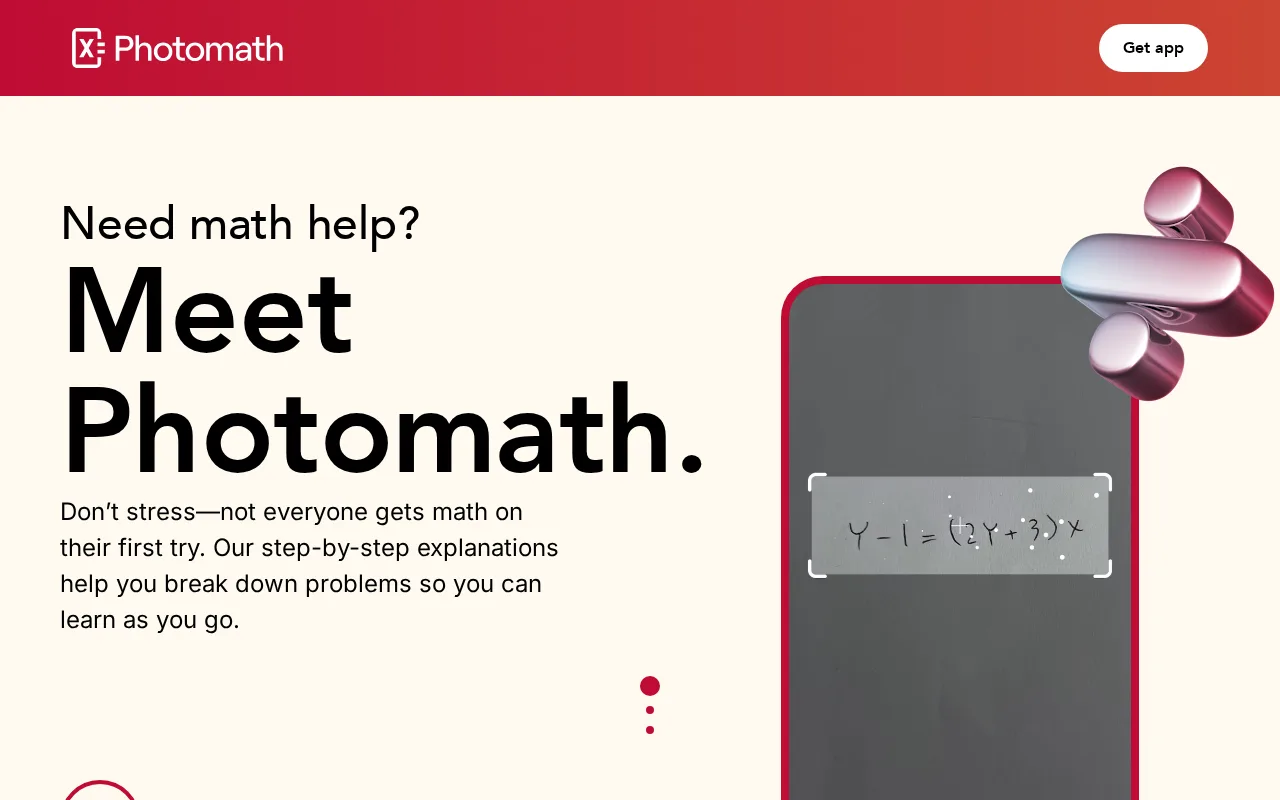
- Photomath is a mobile app that scans math problems and provides step-by-step solutions.
- How much does it cost?
- Photomath offers a free plan and a paid subscription called Photomath Plus for additional features.
- Does it have a free plan?
- Yes, the free plan allows scanning and solving basic math problems with limited steps.
- What integrations does it support?
- Photomath primarily functions as a standalone mobile app with no known third-party integrations.
- Who is it best for?
- It is best for students and learners needing quick, clear math problem solutions on mobile devices.
- What is this tool?
- Cognii Virtual Learning Assistant automates grading and provides instant feedback for open-response educational assessments.
- How much does it cost?
- Cognii offers a freemium pricing model with a free plan and paid options for expanded institutional use.
- Does it have a free plan?
- Yes, Cognii provides a free plan with basic grading and feedback features.
- What integrations does it support?
- Cognii has limited native integrations and does not offer a public API.
- Who is it best for?
- It is best suited for educators and institutions needing automated grading for open-ended student responses.
| Info | Photomath | Cognii Virtual Learning Assistant |
|---|---|---|
| Pricing | Freemium | Freemium |
| Category | Education, Learning & EdTech AI | Education, Learning & EdTech AI |
| Deployment | Cloud | Cloud |
| Learning Curve | Beginner | Beginner |
| Free Plan | ✓ | ✓ |
| AI Agent | ✓ | ✓ |
| Autonomy | Assistant | Assistant |
| Risk Tier | Low | Low |
 Cognii Virtual Learning Assistant vs
  Nolej
Nolej
 Photomath vs
  Khanmigo
 ScribeSense vs Cognii Virtual Learning Assistant
Photomath vs Nolej
Cognii Virtual Learning Assistant vs
ScribeSense vs Cognii Virtual Learning Assistant
Photomath vs Nolej
Cognii Virtual Learning Assistant vs  Coursebox
Cognii Virtual Learning Assistant vs Khanmigo
Cognii Virtual Learning Assistant vs
Coursebox
Cognii Virtual Learning Assistant vs Khanmigo
Cognii Virtual Learning Assistant vs  Revision Assistant
 ELSA Speak vs Cognii Virtual Learning Assistant
Cognii Virtual Learning Assistant and Photomath both offer freemium pricing models and have similar overall scores of 5.2/10 and 5.3/10, respectively. Cognii focuses on providing AI-driven tutoring and personalized learning experiences primarily for language and writing skills, while Photomath specializes in solving and explaining math problems using camera-based input, targeting students needing help with mathematics.
ⓘ How Volvenix scores work
Scores are computed by Volvenix — not supplied by the vendors, and not third-party benchmark results. Each 0–10 dimension (Overall, Features, Usability, Support, Pricing) is a directional estimate aggregated from catalog signals — editorial cataloguing, content depth, engagement, and provider-reputation indicators — so treat them as a starting point, not a lab result.
Confidence reflects how complete the underlying data is for both tools; lower confidence means fewer signals were available, not a worse tool. We never accept payment for rankings or scores. More about how Volvenix works →