 Volvenix
Mubert AI vs Soundraw
AI-enhanced independent comparison — features, pros, cons, pricing and rankings.
 ChatGPT
  Claude
  Gemini
  Midjourney
  DALL-E
  Stable Diffusion
  Notion AI
  Canva
Canva  Grammarly
  GitHub Copilot
  ElevenLabs
  Perplexity
  Runway
  Synthesia
  Fireflies.ai
  Hugging Face Hub

| Dimension | Mubert AI | Soundraw |
|---|---|---|
| Accuracy & Reliability | ||
| Ease of Use | ||
| Features & Capability | ||
| Value for Money | ||
| Performance & Speed | ||
| Popularity & Adoption |
Who each tool serves best — and when to pick the other one.
This tool is ideal for content creators, marketers, and brands looking for unique, royalty-free music solutions.
- You need unique music tailored to specific moods or genres.
- You want a continuous music stream for your content.
- Your team requires royalty-free music for commercial use.
Skip this tool if you need completely free music options or if your projects require extensive customization.
- You need a completely free music solution without limitations.
- Free-tier limits are a blocker for extensive projects.
- You require extensive customization options for each track.
The ability to generate continuous, mood-based music tracks.
Ideal for video producers, game developers, and content creators seeking unique music.
- You need unique music tailored to specific projects.
- You want a user-friendly interface for music generation.
- Your team requires extensive customization options.
Skip this tool if you need free music options or have very basic music needs.
- You need completely free music generation tools.
- Free-tier limits are a blocker for your projects.
- You require a wide range of pre-existing music tracks.
The ability to create highly customized music tracks quickly.
A canonical comparison across capabilities common to this category. Vendor-specific extras appear below in "Highlighted Features".
| Capability | Mubert AI | Soundraw |
|---|---|---|
|
Coding Assistance
Writes, explains, or debugs code
|
— | ✓ |
Each tool's marketing-listed features. Where a feature appears under one tool but not the other, it usually reflects how the vendor describes their product — not a definitive capability gap.
- Mood-based music generation — Generates tracks based on user-selected moods
- Continuous Streaming — Provides uninterrupted music playback
- Royalty-free music — Allows commercial use without licensing issues
- Collaboration Tools — Features for team collaboration on music projects
- Music Generation — Create unique tracks based on user input
- Customization Options — Extensive options for tailoring music
- User-friendly interface — Easy to navigate and use
- Collaborative features — Work with teams on music projects
- Multiple Genres — Supports a variety of music styles
- Generates unique music tracks
- Offers continuous streaming
- Ideal for commercial projects
- Customizable music tracks
- User-friendly interface
- Great for various creative projects
- Supports multiple genres
- Ideal for content creators
- Pricing may be a barrier for some users
- Limited customization options for individual tracks
- Pricing may be high for casual users
- Limited free options available
- Background music for videos
- Soundtrack for podcasts
- Music for live streams
- Audio for marketing campaigns
- Creating background music for videos
- Generating soundtracks for games
- Producing unique audio for podcasts
- Customizing music for events
Where each tool runs — web, mobile, desktop, browser extension, API.
The underlying AI models each tool runs on. Model details show on hover.
No models confirmed.
Natural languages each tool generates and understands. Primary languages are listed first.
What each tool can accept (input) and produce (output) — text, image, audio, video, code.
Mubert offers a paid subscription model with different tiers for individuals and teams.
-
Pro
popular
$20.00/mo -
Team
$30.00/mo
Soundraw offers a paid subscription model with various tiers for different user needs.
-
Pro
popular
$20.00/mo -
Team
$30.00/mo
Regulatory frameworks each tool claims compliance with (HIPAA, SOC 2, GDPR, etc.).
None listed.
Who each tool is positioned for — primary audience first.
No specific audience listed.
How you can reach support — email, live chat, phone, community, docs.
- Email primary
- Email primary
How each tool is classified in the Volvenix catalog.
These vocabulary domains are managed in our catalog but not yet exposed at the tool level. We're tracking them for future expansion of this comparison.
- Encryption Types — AES-256, ChaCha20, RSA-2048, and similar at-rest/in-transit cipher families.
- Encryption Contexts — where encryption is applied (data at rest, in transit, end-to-end).
- Plan-tier Model Mapping — which AI models are available on which pricing tier (currently only the model list is tracked, not the per-plan availability).

- What is this tool?
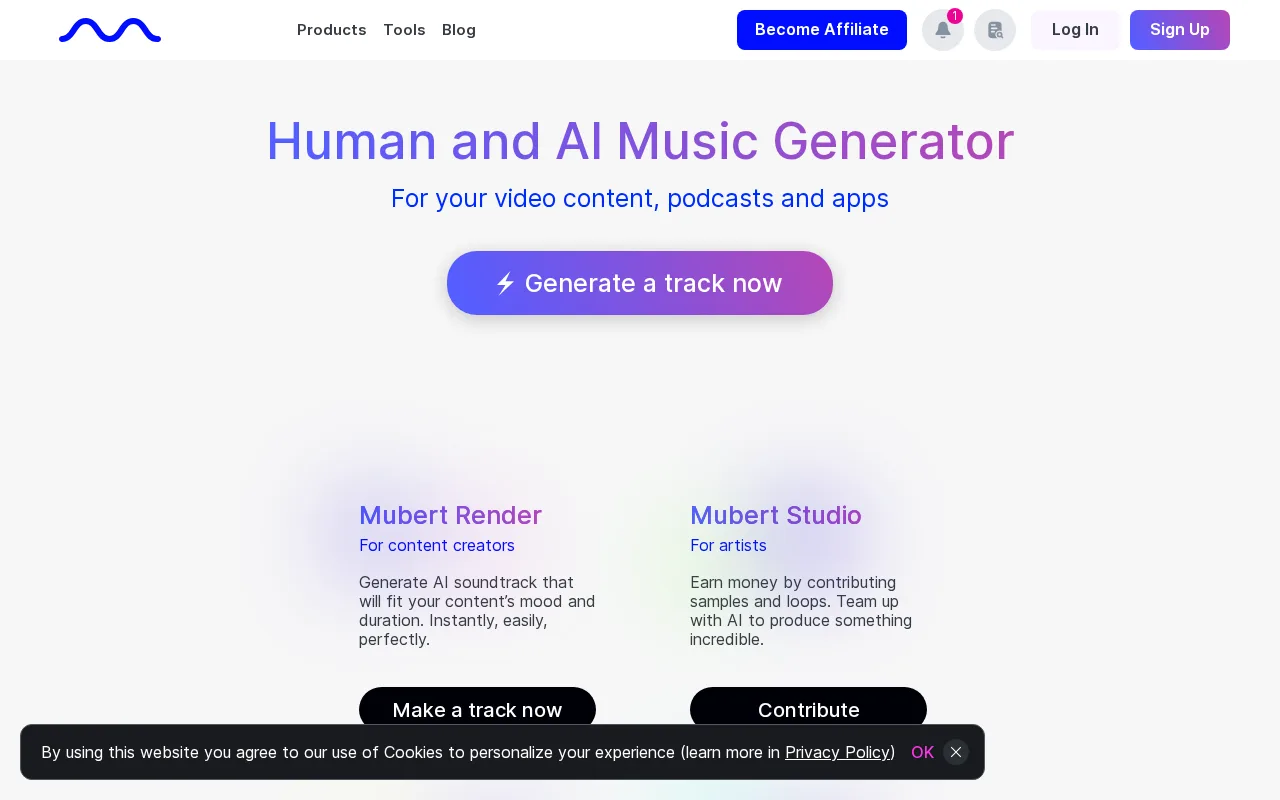
- Mubert AI generates royalty-free music tracks based on mood or genre.
- How much does it cost?
- Mubert offers subscription plans starting at $20 per month.
- Does it have a free plan?
- No, Mubert does not offer a free plan.
- What integrations does it support?
- Mubert does not currently list any integrations.
- Who is it best for?
- It's best for content creators and brands needing unique music solutions.
- What is this tool?
- Soundraw is a music generation tool that creates unique tracks.
- How much does it cost?
- Soundraw offers subscription plans starting at $20/month.
- Does it have a free plan?
- No, Soundraw does not offer a free plan.
- What integrations does it support?
- Currently, Soundraw does not list any integrations.
- Who is it best for?
- It's best for video producers, game developers, and content creators.
| Info | Mubert AI | Soundraw |
|---|---|---|
| Pricing | Paid | Paid |
| Category | AI Music Generation | Code & Developer AI |
| Deployment | Cloud | Cloud |
| Learning Curve | Beginner | — |
| Free Plan | ✗ | ✗ |
| AI Agent | ✗ | ✗ |
 Beatoven.ai
 Magenta Studio
 Dolby.io Media APIs
 Soundful AI
 Udio
Udio Suno AI
 NarrativeFlow
Mubert AI has an overall score of 5.6/10 and operates on a paid pricing model, primarily focusing on AI-generated music for streaming, content creation, and commercial use with real-time music generation capabilities. Soundraw, scoring 5.4/10 and also paid, emphasizes customizable AI music composition tailored for video creators and marketers, offering user-driven editing features to adjust song length and mood. While both provide AI-driven music solutions, Mubert AI leans towards continuous music generation, whereas Soundraw centers on customizable tracks for specific projects.
ⓘ How Volvenix scores work
Scores are computed by Volvenix — not supplied by the vendors, and not third-party benchmark results. Each 0–10 dimension (Overall, Features, Usability, Support, Pricing) is a directional estimate aggregated from catalog signals — editorial cataloguing, content depth, engagement, and provider-reputation indicators — so treat them as a starting point, not a lab result.
Confidence reflects how complete the underlying data is for both tools; lower confidence means fewer signals were available, not a worse tool. We never accept payment for rankings or scores. More about how Volvenix works →