 Volvenix
Metaflow vs ColossalAI
AI-enhanced independent comparison — features, pros, cons, pricing and rankings.
 ChatGPT
  Claude
  Gemini
  Midjourney
  DALL-E
  Stable Diffusion
  Notion AI
  Canva
Canva  Grammarly
  GitHub Copilot
  ElevenLabs
  Perplexity
  Runway
  Synthesia
  Fireflies.ai
  Hugging Face Hub
| Dimension | Metaflow | ColossalAI |
|---|---|---|
| Accuracy & Reliability | — | |
| Ease of Use | — | |
| Features & Capability | — | |
| Value for Money | — | |
| Performance & Speed | — | |
| Popularity & Adoption | — |
Who each tool serves best — and when to pick the other one.
Data science teams looking for a robust framework to manage ML workflows with minimal overhead.
- You need to convert notebook experiments into production pipelines.
- You want strong lineage tracking for your ML workflows.
- Your team requires minimal boilerplate code to get started.
Teams not using AWS or those needing extensive customization may find it limiting.
- You need a tool that supports multiple cloud providers.
- Free-tier limits are a blocker for your team’s needs.
- You require extensive customization options.
The ability to seamlessly integrate with AWS services.
Ideal for AI researchers and developers looking to train large models efficiently.
- You need to train large-scale AI models efficiently.
- You want optimized resource management during training.
- Your team requires advanced parallelism features.
Not suitable for users needing extensive free features or those with limited technical expertise.
- You need extensive free features beyond basic training.
- You require a user-friendly interface without technical complexity.
- You are not focused on AI model training.
The ability to efficiently manage resources during large-scale model training.
A canonical comparison across capabilities common to this category. Vendor-specific extras appear below in "Highlighted Features".
| Capability | Metaflow | ColossalAI |
|---|---|---|
|
Free Tier Available
Usable without payment (with usage limits)
|
✓ | ✓ |
Each tool's marketing-listed features. Where a feature appears under one tool but not the other, it usually reflects how the vendor describes their product — not a definitive capability gap.
- Workflow Management — Easily manage ML workflows
- Lineage Tracking — Track data and model lineage
- Integration with AWS — Seamless integration with AWS services
- Optimized Parallelism — Enhances training speed and efficiency.
- Memory Management — Reduces resource consumption during training.
- Collaborative features — Supports team-based model training.
- Community Support — Access to a vibrant community for assistance.
- Open-Source — Available for developers to modify and contribute.
- User-friendly interface for data scientists
- Strong AWS integration
- Effective lineage tracking
- Open-source and free to use
- Minimal boilerplate code required
- Optimized for large-scale model training
- Efficient resource management
- Strong community support
- Flexible pricing options
- Open-source availability
- Limited flexibility for non-AWS users
- May require AWS expertise
- Free tier has significant limitations
- Requires technical expertise to fully utilize
- Managing ML experiments
- Tracking data lineage
- Integrating with AWS services
- Training large AI models
- Collaborative research projects
- Optimizing model performance
- Resource management in AI training
No third-party integrations confirmed.
Where each tool runs — web, mobile, desktop, browser extension, API.
No platforms confirmed.
Natural languages each tool generates and understands. Primary languages are listed first.
What each tool can accept (input) and produce (output) — text, image, audio, video, code.
Metaflow is completely free to use, making it accessible for individuals and teams.
-
Free
popular
Free
ColossalAI offers a free plan with limited features and paid plans for more advanced capabilities.
-
Free
Free -
Pro
popular
$20.00/mo -
Team
$30.00/mo
Languages, frameworks, databases, and infrastructure each tool is built on. Mostly relevant for self-hosted or open-source tools.
Stack not disclosed.
Who each tool is positioned for — primary audience first.
No specific audience listed.
How each tool is classified in the Volvenix catalog.
These vocabulary domains are managed in our catalog but not yet exposed at the tool level. We're tracking them for future expansion of this comparison.
- Encryption Types — AES-256, ChaCha20, RSA-2048, and similar at-rest/in-transit cipher families.
- Encryption Contexts — where encryption is applied (data at rest, in transit, end-to-end).
- Plan-tier Model Mapping — which AI models are available on which pricing tier (currently only the model list is tracked, not the per-plan availability).
- What is this tool?
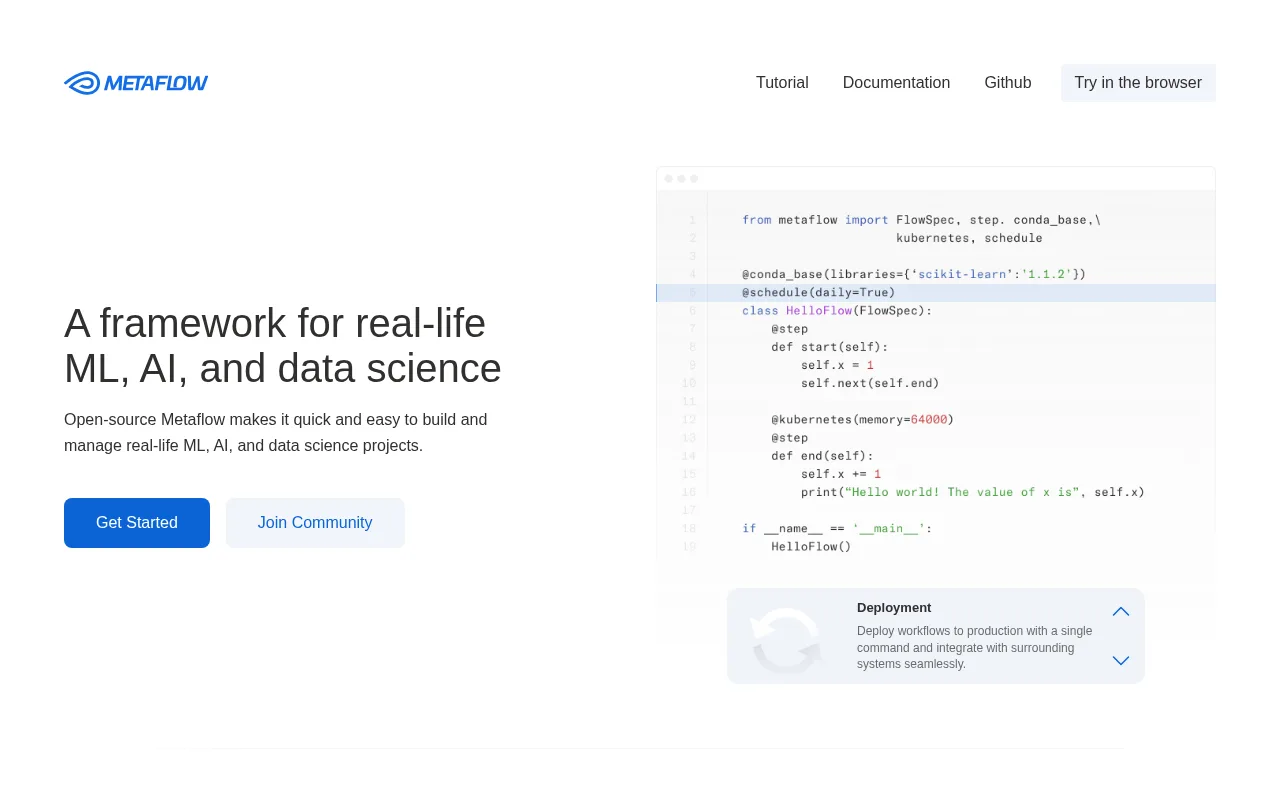
- Metaflow is an open-source framework for managing ML workflows.
- How much does it cost?
- Metaflow is completely free to use.
- Does it have a free plan?
- Yes, Metaflow is free.
- What integrations does it support?
- Metaflow integrates seamlessly with AWS.
- Who is it best for?
- It's best for data science teams looking for efficient ML workflow management.
- What is this tool?
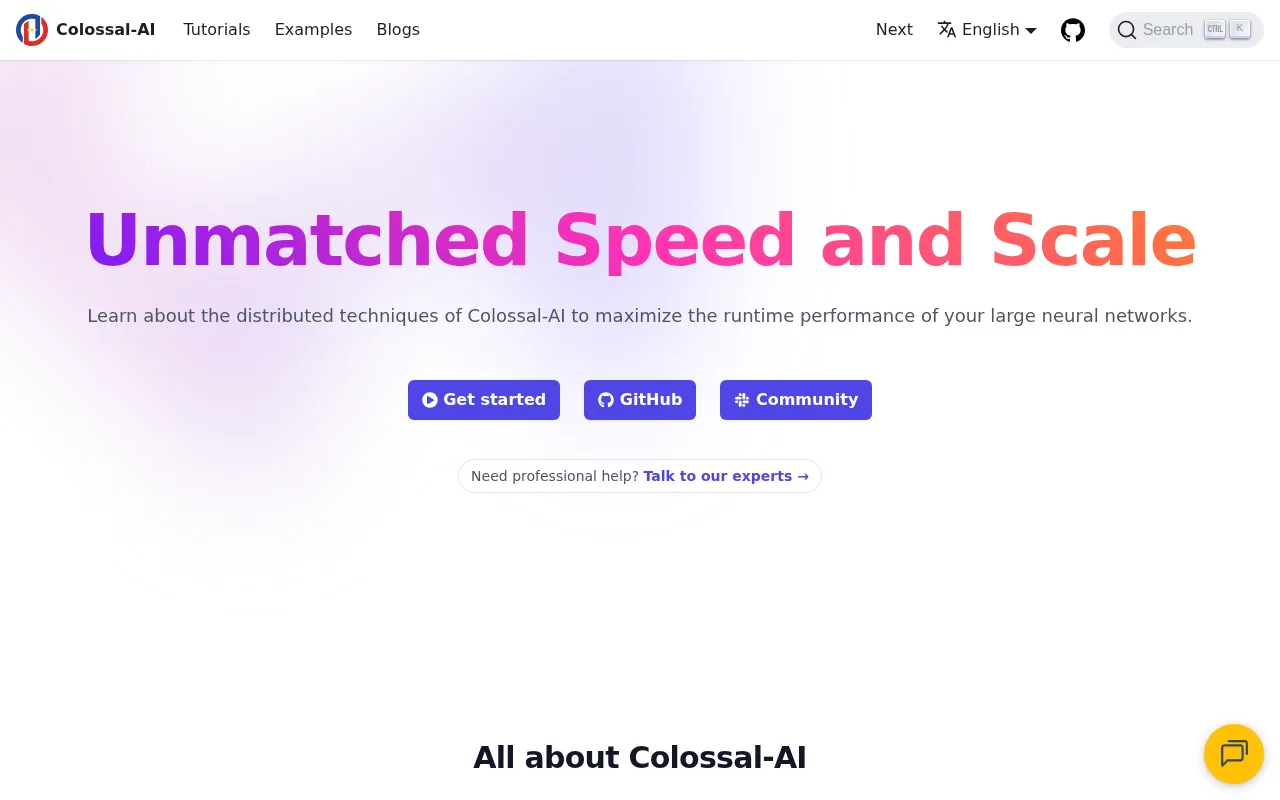
- ColossalAI is a tool for training large-scale AI models efficiently.
- How much does it cost?
- ColossalAI offers a free plan and paid subscriptions starting at $20/month.
- Does it have a free plan?
- Yes, ColossalAI has a free plan with limited features.
- What integrations does it support?
- Integrations are not explicitly listed on the website.
- Who is it best for?
- It's best for AI researchers and developers focused on large model training.
| Info | Metaflow | ColossalAI |
|---|---|---|
| Pricing | Free | Freemium |
| Category | Data Engineering, MLOps & Pipelines | Data Engineering, MLOps & Pipelines |
| Deployment | Cloud | Cloud |
| Learning Curve | Advanced | — |
| Free Plan | ✓ | ✓ |
| AI Agent | ✓ | ✗ |
 Akkio
Akkio Hopsworks
 Obviously AI
 FeatureByte
 Azure Machine Learning
 Featureform
 Kaskada
 Dataiku
Metaflow has an overall score of 5.8/10 and is offered for free, focusing on simplifying data science workflows and managing machine learning projects. ColossalAI, with a slightly lower overall score of 5.1/10, uses a freemium pricing model and is designed to optimize large-scale AI model training with distributed computing features. While Metaflow emphasizes ease of use and workflow management, ColossalAI targets performance improvements in training large neural networks.
ⓘ How Volvenix scores work
Scores are computed by Volvenix — not supplied by the vendors, and not third-party benchmark results. Each 0–10 dimension (Overall, Features, Usability, Support, Pricing) is a directional estimate aggregated from catalog signals — editorial cataloguing, content depth, engagement, and provider-reputation indicators — so treat them as a starting point, not a lab result.
Confidence reflects how complete the underlying data is for both tools; lower confidence means fewer signals were available, not a worse tool. We never accept payment for rankings or scores. More about how Volvenix works →