 Volvenix
Limbic vs Woebot Health
AI-enhanced independent comparison — features, pros, cons, pricing and rankings.
 ChatGPT
  Claude
  Gemini
  Midjourney
  DALL-E
  Stable Diffusion
  Notion AI
  Canva
Canva  Grammarly
  GitHub Copilot
  ElevenLabs
  Perplexity
  Runway
  Synthesia
  Fireflies.ai
  Hugging Face Hub

Who each tool serves best — and when to pick the other one.
Healthcare providers and mental health organizations looking to deploy AI chatbots for scalable, personalized emotional support.
- You want to provide scalable mental health support with AI chatbots tailored to users' emotions.
- You need a tool focused on behavioral and mental health therapeutic conversations.
- Your team requires a solution that combines AI with evidence-based therapeutic techniques.
Teams requiring extensive third-party integrations or API access for complex workflows should consider other solutions.
- You need extensive API access for custom integrations and automation workflows.
- Free-tier limits are a blocker for your organization's usage volume or feature needs.
- You require a platform with broad third-party app integrations for healthcare systems.
Effectiveness of AI-driven therapeutic chatbot engagement for behavioral health support.
Individuals looking for accessible, daily mental health support through conversational AI and CBT techniques.
- You want daily, conversational mental health support without scheduling appointments
- You need a self-guided tool to practice cognitive behavioral therapy techniques
- Your team requires a scalable, accessible mental health resource for users
People requiring intensive clinical therapy or crisis intervention should not rely solely on this tool.
- You need immediate crisis intervention or emergency mental health services
- Free-tier limits are a blocker for your long-term mental health management
- You require personalized, in-depth clinical therapy from licensed professionals
Effectiveness of chatbot-driven cognitive behavioral therapy for ongoing mental health support.
A canonical comparison across capabilities common to this category. Vendor-specific extras appear below in "Highlighted Features".
| Capability | Limbic | Woebot Health |
|---|---|---|
|
API Access
Programmatic access via documented API
|
✓ | — |
|
Free Tier Available
Usable without payment (with usage limits)
|
✓ | ✓ |
Each tool's marketing-listed features. Where a feature appears under one tool but not the other, it usually reflects how the vendor describes their product — not a definitive capability gap.
- Therapeutic Chatbots — AI chatbots delivering personalized mental health support
- Personalization — Tailors conversations based on user emotional state
- Cloud deployment — Accessible via web without local installation
- Third-party Integrations — Limited or no integrations available
- Conversational AI Chatbot — Engages users in therapeutic conversations
- Cognitive Behavioral Therapy Techniques — Delivers evidence-based CBT exercises
- Mood tracking — Daily mood check-ins and insights
- Personalized Content — Tailored mental health exercises
- Integration with Health Providers — Supports clinical partnerships
- Specialized in behavioral and mental health AI chatbots
- Personalized therapeutic conversations improve user engagement
- Cloud-based deployment for easy access
- Freemium pricing lowers entry barriers
- Clinically informed AI approach
- User-friendly conversational interface
- Based on cognitive behavioral therapy
- Accessible 24/7 mental health support
- Engages users with daily check-ins
- Supports emotional well-being self-management
- Limited third-party integrations
- No public API for custom workflows
- No dedicated mobile app
- Not a replacement for professional therapy
- Limited support for crisis situations
- Free plan has limited features
- Providing scalable mental health support
- Engaging users with personalized therapeutic conversations
- Supporting behavioral health programs
- Improving emotional well-being through AI chatbots
- Supplementing traditional therapy with digital tools
- Daily mental health check-ins
- Self-guided cognitive behavioral therapy
- Emotional well-being support
- Early intervention for mood disorders
- Scalable mental health resource for organizations
Where each tool runs — web, mobile, desktop, browser extension, API.
Natural languages each tool generates and understands. Primary languages are listed first.
What each tool can accept (input) and produce (output) — text, image, audio, video, code.
Offers a free tier with basic chatbot features and paid plans for enhanced capabilities and higher usage limits.
-
Free
Free
Offers a free plan with basic chatbot access and paid subscriptions for enhanced features and content.
-
Free
Free
Regulatory frameworks each tool claims compliance with (HIPAA, SOC 2, GDPR, etc.).
Vendor-published numbers each tool highlights — usage scale, breadth, and operational stats. Different tools track different metrics, so direct row-by-row comparison usually isn't meaningful.
- User Engagement High
- User Engagement Millions of conversations monthly
Who each tool is positioned for — primary audience first.
How you can reach support — email, live chat, phone, community, docs.
- Email primary
- Email primary
How each tool is classified in the Volvenix catalog.
These vocabulary domains are managed in our catalog but not yet exposed at the tool level. We're tracking them for future expansion of this comparison.
- Encryption Types — AES-256, ChaCha20, RSA-2048, and similar at-rest/in-transit cipher families.
- Encryption Contexts — where encryption is applied (data at rest, in transit, end-to-end).
- Plan-tier Model Mapping — which AI models are available on which pricing tier (currently only the model list is tracked, not the per-plan availability).
- What is this tool?
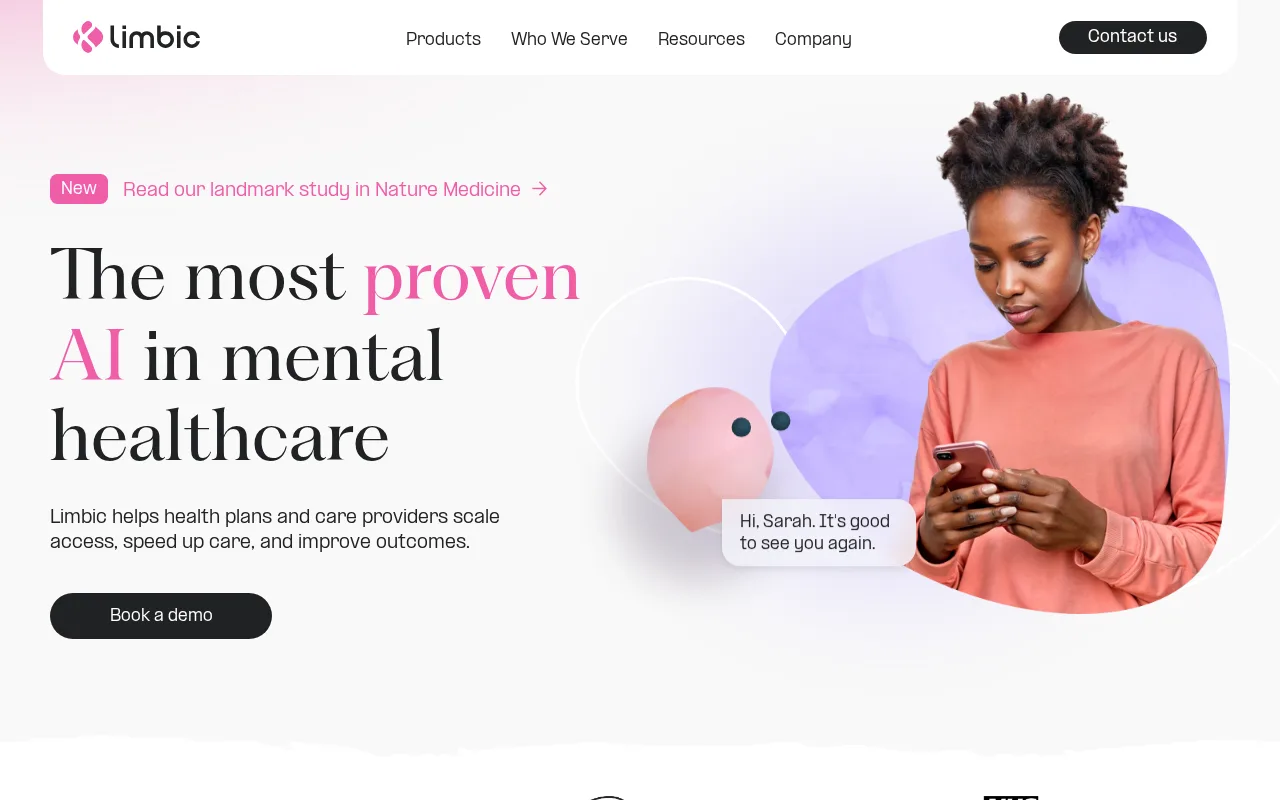
- Limbic is an AI platform offering therapeutic chatbots that provide personalized mental health support.
- How much does it cost?
- Limbic offers a freemium pricing model with a free tier and paid plans for enhanced features.
- Does it have a free plan?
- Yes, Limbic provides a free plan with basic chatbot features and limited usage.
- What integrations does it support?
- Currently, Limbic has limited third-party integrations and no public API.
- Who is it best for?
- It is best suited for healthcare providers and organizations seeking scalable AI-driven mental health support.
- What is this tool?
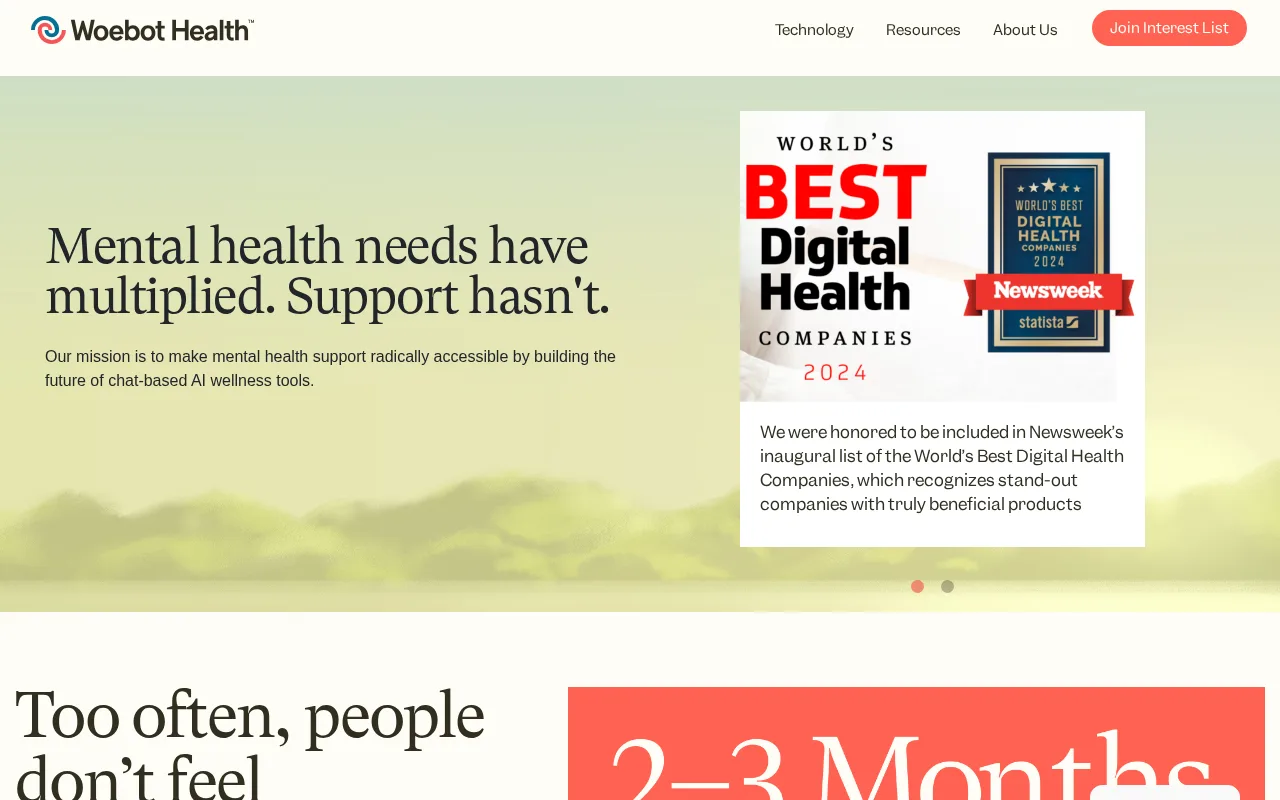
- Woebot Health is a conversational AI chatbot that provides therapeutic mental health support using cognitive behavioral therapy.
- How much does it cost?
- Woebot Health offers a free plan with basic features and paid subscriptions for enhanced content and personalized support.
- Does it have a free plan?
- Yes, Woebot Health provides a free plan that includes basic chatbot access and daily mood tracking.
- What integrations does it support?
- Woebot Health supports clinical partnerships but does not publicly list third-party SaaS integrations.
- Who is it best for?
- It is best for individuals seeking accessible, self-guided mental health support through conversational AI.
| Info | Limbic | Woebot Health |
|---|---|---|
| Pricing | Freemium | Freemium |
| Category | Healthcare & Medical AI | Healthcare & Medical AI |
| Deployment | Cloud | Cloud |
| Learning Curve | Beginner | Beginner |
| Free Plan | ✓ | ✓ |
| AI Agent | ✗ | ✗ |
| Autonomy | Assistant | Assistant |
| Risk Tier | Low | Low |
 Ada Health
 Woebot
 K Health
 LumaMind
 Wysa
Wysa OptiMind
 Youper
Woebot Health and Limbic both have an overall score of 5.1/10 and offer freemium pricing models. Woebot Health focuses on delivering AI-driven mental health support through conversational agents designed for general emotional well-being and cognitive behavioral therapy techniques. Limbic, on the other hand, emphasizes personalized mental health interventions with a stronger integration of clinical assessments and tailored treatment plans, targeting users seeking more structured therapeutic guidance.
ⓘ How Volvenix scores work
Scores are computed by Volvenix — not supplied by the vendors, and not third-party benchmark results. Each 0–10 dimension (Overall, Features, Usability, Support, Pricing) is a directional estimate aggregated from catalog signals — editorial cataloguing, content depth, engagement, and provider-reputation indicators — so treat them as a starting point, not a lab result.
Confidence reflects how complete the underlying data is for both tools; lower confidence means fewer signals were available, not a worse tool. We never accept payment for rankings or scores. More about how Volvenix works →