 Volvenix
Portkey vs IBM Watson Machine Learning
AI-enhanced independent comparison — features, pros, cons, pricing and rankings.
 ChatGPT
 Claude
 Gemini
 Midjourney
 DALL-E
 Stable Diffusion
 Notion AI
 Canva
 Grammarly
 GitHub Copilot
 ElevenLabs
 Perplexity
 Runway
 Synthesia
 Fireflies.ai
 Hugging Face Hub


| Dimension | Portkey | IBM Watson Machine Learning |
|---|---|---|
| Accuracy & Reliability | ||
| Ease of Use | ||
| Features & Capability | ||
| Value for Money | ||
| Performance & Speed | ||
| Popularity & Adoption |
Who each tool serves best — and when to pick the other one.
Developer teams seeking a unified API to manage multiple LLMs with built-in monitoring and cost controls.
- You need to integrate multiple LLMs through a single API gateway efficiently.
- You want built-in observability and cost control for AI model usage.
- Your team requires streamlined deployment workflows for large language models.
Organizations requiring extensive third-party integrations or enterprise-grade security should consider other solutions.
- You need extensive third-party SaaS integrations beyond LLM management.
- Free-tier limits are a blocker for your high-volume AI usage needs.
- You require enterprise-grade security certifications and compliance features.
Unified API gateway for simplified LLM integration and deployment management.
Data science teams and enterprises requiring scalable, secure model deployment integrated with IBM Cloud services.
- You need to deploy and manage ML models at enterprise scale with IBM Cloud integration
- You want robust MLOps features including monitoring and lifecycle management
- Your team requires support for multiple ML frameworks and Watson AI services
Small startups or individual developers seeking simple, low-cost model deployment without IBM Cloud dependencies.
- You need a lightweight or purely open-source model deployment solution
- Free-tier limits are a blocker for your experimentation or prototyping needs
- You require simple, standalone model hosting without cloud vendor lock-in
Integration with IBM Cloud ecosystem and enterprise-grade scalability.
A canonical comparison across capabilities common to this category. Vendor-specific extras appear below in "Highlighted Features".
| Capability | Portkey | IBM Watson Machine Learning |
|---|---|---|
|
Free Tier Available
Usable without payment (with usage limits)
|
✓ | ✓ |
Each tool's marketing-listed features. Where a feature appears under one tool but not the other, it usually reflects how the vendor describes their product — not a definitive capability gap.
- Unified API Gateway — Single API to access multiple LLMs
- Observability — Monitoring and logging of model usage
- Cost Control — Tools to manage and optimize AI spending
- Multi-model Support — Supports integration of various LLM providers
- Team collaboration — Shared access and management for teams
- Model deployment — Deploy models from multiple ML frameworks
- Model Monitoring — Track model performance and drift
- Integrations — Integrates with IBM Watson AI services
- Auto Scaling — Automatic scaling of deployed models
- Pipeline orchestration — Supports MLOps pipelines
- Simplifies integration of multiple LLMs
- Provides clear observability dashboards
- Includes cost management tools
- Easy-to-use unified API gateway
- Focused on developer experience
- Enterprise-grade scalability and security
- Supports multiple ML frameworks and Watson AI services
- Integrated model lifecycle management
- Robust monitoring and governance features
- Seamless IBM Cloud ecosystem integration
- Limited third-party integrations
- No advanced enterprise security features
- No public API documentation available
- Complex for beginners and small teams
- Pricing and free-tier limits may restrict experimentation
- Centralize LLM API management
- Monitor AI model usage and performance
- Control AI deployment costs
- Simplify multi-model integration
- Optimize AI infrastructure for teams
- Enterprise model deployment and management
- MLOps lifecycle automation
- Model monitoring and governance
- Integration with Watson AI services
- Scalable cloud-based ML hosting
Natural languages each tool generates and understands. Primary languages are listed first.
What each tool can accept (input) and produce (output) — text, image, audio, video, code.
Offers a free tier with basic features and paid plans for enhanced usage and capabilities.
-
Free
Free
Offers a free tier with limited usage; paid plans scale with usage and enterprise needs, pricing details require IBM contact.
-
Lite
Free
Regulatory frameworks each tool claims compliance with (HIPAA, SOC 2, GDPR, etc.).
Third-party audits and certifications that verify security controls.
Vendor-published numbers each tool highlights — usage scale, breadth, and operational stats. Different tools track different metrics, so direct row-by-row comparison usually isn't meaningful.
- Monthly requests processed 10M+ requests
- Scalability Enterprise-grade
- Integration IBM Cloud ecosystem
Who each tool is positioned for — primary audience first.
How you can reach support — email, live chat, phone, community, docs.
- Documentation primary
- Documentation primary visit ↗
How each tool is classified in the Volvenix catalog.
These vocabulary domains are managed in our catalog but not yet exposed at the tool level. We're tracking them for future expansion of this comparison.
- Encryption Types — AES-256, ChaCha20, RSA-2048, and similar at-rest/in-transit cipher families.
- Encryption Contexts — where encryption is applied (data at rest, in transit, end-to-end).
- Plan-tier Model Mapping — which AI models are available on which pricing tier (currently only the model list is tracked, not the per-plan availability).

- What is this tool?
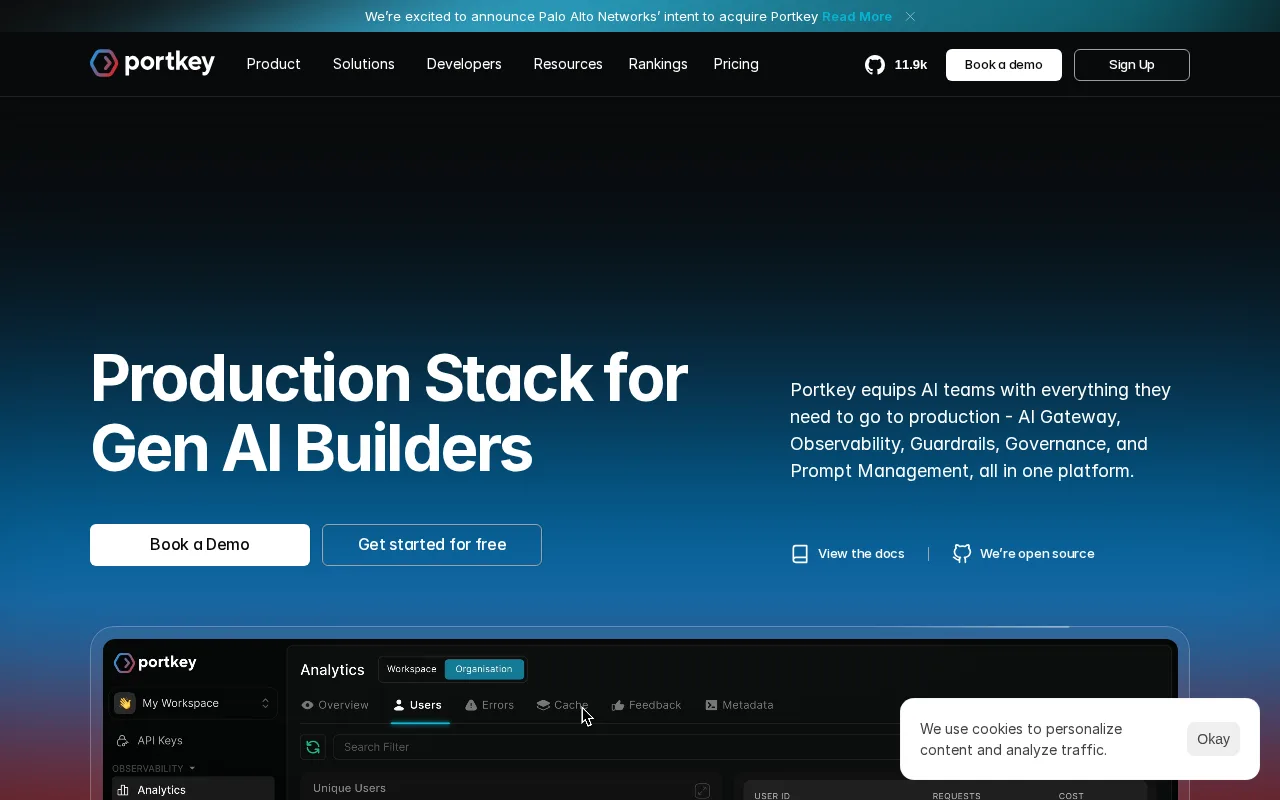
- Portkey is a unified API gateway designed to simplify integration and management of large language models for developers.
- How much does it cost?
- Portkey offers a free tier with basic features; pricing for advanced plans is available upon request.
- Does it have a free plan?
- Yes, Portkey provides a free plan suitable for individuals and basic usage.
- What integrations does it support?
- Portkey supports multiple large language model providers through its unified API, but no extensive third-party SaaS integrations are documented.
- Who is it best for?
- It is best suited for developer teams looking to streamline LLM deployment with monitoring and cost management.
- What is this tool?
- IBM Watson Machine Learning is a cloud platform for deploying and managing machine learning models.
- How much does it cost?
- It offers a free Lite plan with limited usage; paid plans vary and require contacting IBM for details.
- Does it have a free plan?
- Yes, a free Lite plan is available with limited features and usage.
- What integrations does it support?
- It integrates with IBM Watson AI services and supports multiple ML frameworks.
- Who is it best for?
- Best suited for enterprises and teams needing scalable, secure model deployment integrated with IBM Cloud.
Portkey AI
—
| Info | Portkey | IBM Watson Machine Learning |
|---|---|---|
| Pricing | Freemium | Freemium |
| Launch Year | 2023 | — |
| Category | LLM Observability & Monitoring | Data Engineering, MLOps & Pipelines |
| Deployment | Cloud | Cloud |
| Learning Curve | Intermediate | Intermediate |
| Free Plan | ✓ | ✓ |
| AI Agent | ✓ | ✗ |
| Autonomy | Assistant | Copilot |
| Risk Tier | Medium | Medium |
 Ascend
 Lmdeploy
 SAS Model Manager
 Inferex
 Prophecy
 Modal
 PromptLayer
 Pecan AI
Portkey (5.6) and IBM Watson Machine Learning (5.6) score within our confidence interval — treat this as a tie for practical purposes. Portkey leads on support. Pick based on the specific dimensions that matter to your workflow.
ⓘ How Volvenix scores work
Scores are computed by Volvenix — not supplied by the vendors, and not third-party benchmark results. Each 0–10 dimension (Overall, Features, Usability, Support, Pricing) is a directional estimate aggregated from catalog signals — editorial cataloguing, content depth, engagement, and provider-reputation indicators — so treat them as a starting point, not a lab result.
Confidence reflects how complete the underlying data is for both tools; lower confidence means fewer signals were available, not a worse tool. We never accept payment for rankings or scores. More about how Volvenix works →