 Volvenix
Hugging Face Hub vs Protect AI
AI-enhanced independent comparison — features, pros, cons, pricing and rankings.
 ChatGPT
  Claude
  Gemini
  Midjourney
  DALL-E
  Stable Diffusion
  Notion AI
  Canva
Canva  Grammarly
  GitHub Copilot
  ElevenLabs
  Perplexity
  Runway
  Synthesia
  Fireflies.ai
  Hugging Face Hub
| Dimension | Hugging Face Hub | Protect AI |
|---|---|---|
| Accuracy & Reliability | ||
| Ease of Use | ||
| Features & Capability | ||
| Value for Money | ||
| Performance & Speed | ||
| Popularity & Adoption |
Who each tool serves best — and when to pick the other one.
Developers, researchers, and organizations seeking an open platform for sharing and deploying ML models collaboratively.
- You want to share and collaborate on machine learning models openly with a community.
- You need a centralized platform to deploy and manage ML models and datasets.
- Your team requires integration with popular ML frameworks and reproducible workflows.
Users needing enterprise-grade governance, extensive private deployment options, or advanced security compliance may find it insufficient.
- You need strict enterprise governance and compliance features beyond the freemium tier.
- Free-tier limits are a blocker for large-scale private model hosting and deployment.
- You require on-premise deployment or extensive offline capabilities.
The platform’s strength lies in its open model sharing and seamless integration with ML workflows.
Enterprise teams deploying AI models at scale who need to secure pipelines and ensure governance compliance.
- You need to identify and mitigate AI model vulnerabilities before deployment.
- You want to ensure compliance with AI governance and risk management policies.
- Your team requires continuous monitoring of AI pipelines for security threats.
Small businesses or startups without complex AI infrastructure or those seeking broad AI development tools.
- You need a general-purpose AI development or experimentation platform.
- Free-tier limits are a blocker for your small-scale AI projects.
- You require extensive third-party integrations beyond AI security.
Comprehensive vulnerability detection and governance compliance for AI models and pipelines.
A canonical comparison across capabilities common to this category. Vendor-specific extras appear below in "Highlighted Features".
| Capability | Hugging Face Hub | Protect AI |
|---|---|---|
|
Free Tier Available
Usable without payment (with usage limits)
|
✓ | ✓ |
Each tool's marketing-listed features. Where a feature appears under one tool but not the other, it usually reflects how the vendor describes their product — not a definitive capability gap.
- Model hosting — Host and share ML models publicly or privately
- Dataset Sharing — Upload and share datasets with the community
- Model versioning — Track changes and versions of models
- Private Repositories — Host private models and datasets
- Community collaboration — Engage with a large AI research community
- Vulnerability scanning — Detects security issues in AI models and pipelines
- Data poisoning detection — Identifies attempts to corrupt training data
- Supply Chain Risk Analysis — Assesses risks from third-party AI components
- Governance Compliance — Supports regulatory and internal policy adherence
- Continuous Monitoring — Ongoing security checks for AI pipelines
- Large open-source model and dataset repository
- Active and supportive community
- Easy integration with popular ML frameworks
- Supports model versioning and collaboration
- Free tier available for individuals
- Comprehensive AI vulnerability scanning
- Focus on data poisoning and supply chain risks
- Governance compliance support
- Enterprise-grade security focus
- Scalable for large AI deployments
- Limited private model hosting in free tier
- Lacks advanced enterprise governance features
- No official mobile app for on-the-go management
- Limited integrations with other AI and security tools
- Not ideal for small teams or startups
- No public API available
- Sharing pre-trained machine learning models
- Collaborative AI research and development
- Deploying models for inference in applications
- Version control for ML models
- Dataset hosting and distribution
- Enterprise AI model security
- AI pipeline vulnerability management
- Data poisoning risk mitigation
- Supply chain risk assessment
- Governance compliance for AI deployments
Natural languages each tool generates and understands. Primary languages are listed first.
What each tool can accept (input) and produce (output) — text, image, audio, video, code.
Offers a free tier with basic hosting and sharing; paid plans add advanced features and team collaboration.
-
Free
Free
Offers a free tier with basic features and paid plans for advanced security and compliance capabilities.
-
Free
Free
Regulatory frameworks each tool claims compliance with (HIPAA, SOC 2, GDPR, etc.).
Vendor-published numbers each tool highlights — usage scale, breadth, and operational stats. Different tools track different metrics, so direct row-by-row comparison usually isn't meaningful.
- Community Models 100,000+ models
- Datasets Hosted 50,000+ datasets
- Vulnerabilities Detected High accuracy in detection
Who each tool is positioned for — primary audience first.
How you can reach support — email, live chat, phone, community, docs.
- Documentation primary
- Email primary
How each tool is classified in the Volvenix catalog.
These vocabulary domains are managed in our catalog but not yet exposed at the tool level. We're tracking them for future expansion of this comparison.
- Encryption Types — AES-256, ChaCha20, RSA-2048, and similar at-rest/in-transit cipher families.
- Encryption Contexts — where encryption is applied (data at rest, in transit, end-to-end).
- Plan-tier Model Mapping — which AI models are available on which pricing tier (currently only the model list is tracked, not the per-plan availability).

- What is this tool?
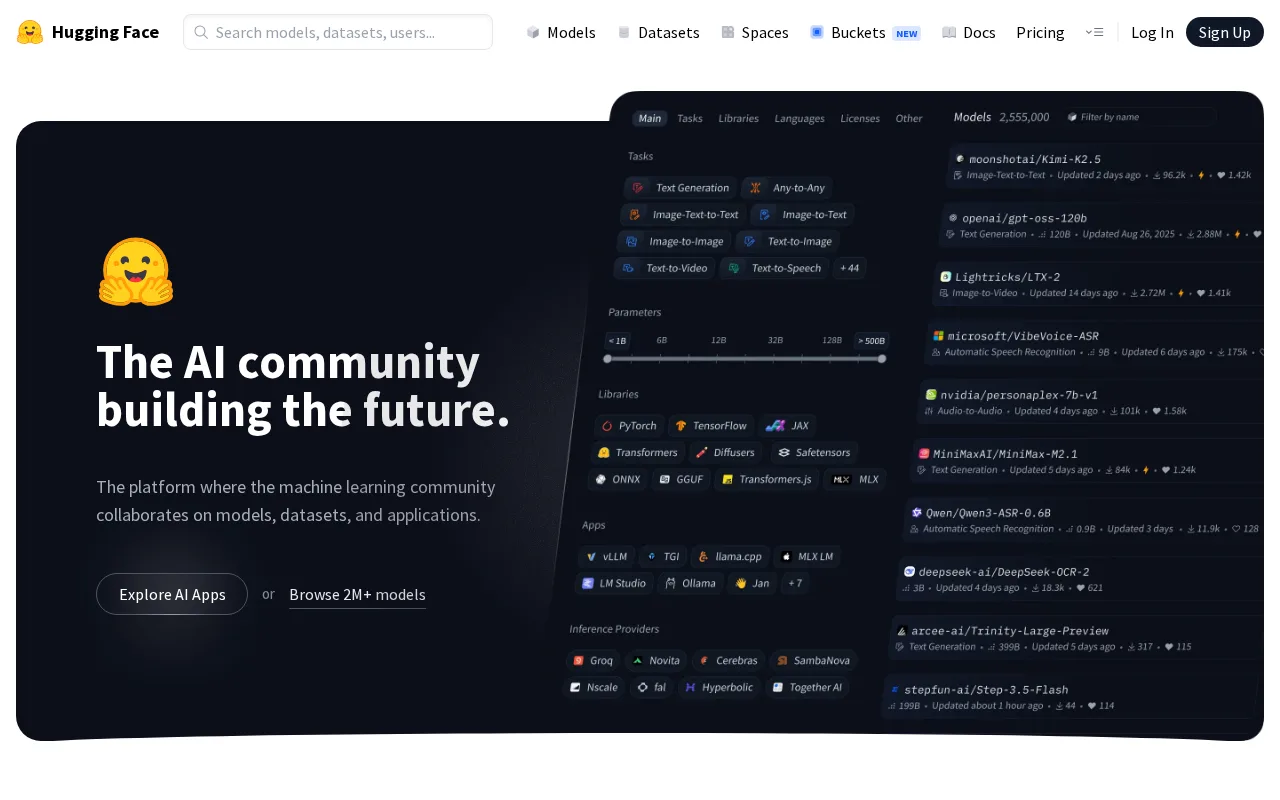
- Hugging Face Hub is a platform to host, share, and deploy machine learning models and datasets.
- How much does it cost?
- It offers a free tier with public hosting; paid plans provide private repositories and advanced features.
- Does it have a free plan?
- Yes, there is a free plan suitable for individuals and open model sharing.
- What integrations does it support?
- It integrates seamlessly with popular ML frameworks like PyTorch and TensorFlow.
- Who is it best for?
- Developers, researchers, and organizations looking to share and deploy ML models collaboratively.
- What is this tool?
- Protect AI scans machine learning models and pipelines to detect vulnerabilities and ensure AI security.
- How much does it cost?
- Protect AI offers a free tier with basic features and paid plans for advanced security and compliance.
- Does it have a free plan?
- Yes, Protect AI provides a free plan with limited vulnerability scanning capabilities.
- What integrations does it support?
- Publicly documented integrations are not available; the platform focuses on core AI security features.
- Who is it best for?
- It is best suited for enterprises deploying AI models at scale needing comprehensive security and governance.
| Info | Hugging Face Hub | Protect AI |
|---|---|---|
| Pricing | Freemium | Freemium |
| Category | Multimodal AI (Text, Image, Audio & Video) | AI Security, Safety & Governance |
| Deployment | Cloud | Cloud |
| Learning Curve | Intermediate | Intermediate |
| Free Plan | ✓ | ✓ |
| AI Agent | ✗ | ✗ |
| Autonomy | Assistant | Assistant |
| Risk Tier | Low | Medium |
| BYO API Key | ✗ | — |
| Local Models | ✓ | — |
| Fine-tuning | ✓ | — |
 Holistic AI
 Immuta
 Playment
 Hugging Face Spaces
 TensorFlow
 Lakera Guard
Hugging Face Hub leads Protect AI overall (5.9 vs 5.7). It scores higher on usability. The best choice depends on your specific workflow, team size, and budget.
ⓘ How Volvenix scores work
Scores are computed by Volvenix — not supplied by the vendors, and not third-party benchmark results. Each 0–10 dimension (Overall, Features, Usability, Support, Pricing) is a directional estimate aggregated from catalog signals — editorial cataloguing, content depth, engagement, and provider-reputation indicators — so treat them as a starting point, not a lab result.
Confidence reflects how complete the underlying data is for both tools; lower confidence means fewer signals were available, not a worse tool. We never accept payment for rankings or scores. More about how Volvenix works →