 Volvenix
Sourcegraph vs Glean
AI-enhanced independent comparison — features, pros, cons, pricing and rankings.
 ChatGPT
  Claude
  Gemini
  Midjourney
  DALL-E
  Stable Diffusion
  Notion AI
  Canva
Canva  Grammarly
  GitHub Copilot
  ElevenLabs
  Perplexity
  Runway
  Synthesia
  Fireflies.ai
  Hugging Face Hub

| Dimension | Sourcegraph | Glean |
|---|---|---|
| Accuracy & Reliability | ||
| Ease of Use | ||
| Features & Capability | ||
| Value for Money | ||
| Performance & Speed | ||
| Popularity & Adoption |
Who each tool serves best — and when to pick the other one.
Engineering teams managing large or multiple codebases who need efficient code search and cross-repository navigation.
- You need to search code across many repositories quickly and accurately
- You want to improve team collaboration through shared code visibility
- Your team requires integration with existing code hosts and IDEs
Individual developers or very small teams with simple codebases who may find Sourcegraph’s setup and features excessive.
- You need a lightweight tool for single repository code browsing
- Free-tier limits are a blocker for your team’s scale or usage
- You require an all-in-one IDE or code editor replacement
The ability to perform fast, universal code search and navigation across multiple repositories.
Mid-sized to large teams needing unified search across multiple workplace apps and documents.
- You need to search across multiple workplace apps and document repositories quickly.
- You want to reduce time spent hunting for information across disconnected tools.
- Your team requires contextual and AI-enhanced search relevance for better answers.
Small teams or individuals with simple search needs or limited budgets may find it too complex or costly.
- You need a simple search tool for a single app or document source only.
- Free-tier limits are a blocker for your team’s search volume or feature needs.
- You require an on-premise or self-hosted search solution.
The ability to unify and contextualize search results across diverse enterprise data sources.
A canonical comparison across capabilities common to this category. Vendor-specific extras appear below in "Highlighted Features".
| Capability | Sourcegraph | Glean |
|---|---|---|
|
Free Tier Available
Usable without payment (with usage limits)
|
✓ | ✓ |
Each tool's marketing-listed features. Where a feature appears under one tool but not the other, it usually reflects how the vendor describes their product — not a definitive capability gap.
- Universal Code Search — Search code across multiple repositories and languages
- IDE Integration — Integrates with VS Code, JetBrains, and others
- Code Intelligence — Provides hover tooltips, go-to-definition, and references
- Self-Hosted Option — Deploy Sourcegraph on your own infrastructure
- Batch Changes — Automate large-scale code refactoring
- Unified Search — Search across multiple workplace apps and documents
- AI Relevance Ranking — Contextual AI to improve search result relevance
- Multi-source Indexing — Indexes data from Slack, Google Drive, Salesforce, and more
- Analytics Dashboard — Insights on search usage and content gaps
- Browser Extension — Quick search access via browser toolbar
- Scalable and fast code search across repositories
- Integrates with popular code hosts and IDEs
- Open source with active community
- Enhances team collaboration and code understanding
- Supports self-hosted and cloud deployment
- Deep integrations with workplace apps
- AI-powered contextual search relevance
- Unified search experience across data sources
- Improves team productivity
- Freemium access for trial
- Setup and configuration can be complex for small teams
- Free plan has limitations on usage and features
- Not a full IDE replacement, focused on search/navigation
- Complex setup for smaller teams
- Advanced features require paid plans
- Cross-repository code search for large engineering teams
- Code review and navigation enhancement
- Automating large-scale code refactors
- Onboarding new developers with codebase exploration
- Improving code collaboration and knowledge sharing
- Employee knowledge discovery
- Customer support knowledge base search
- Sales enablement content search
- Onboarding new employees
- Reducing time spent searching across apps
Natural languages each tool generates and understands. Primary languages are listed first.
What each tool can accept (input) and produce (output) — text, image, audio, video, code.
Sourcegraph offers a free plan for individuals and small teams, with paid plans adding advanced features and higher usage limits.
-
Free
Free -
Team
popular
Custom pricing
Glean offers a free tier with basic search features and paid plans for advanced capabilities and larger teams.
-
Free
Free
Regulatory frameworks each tool claims compliance with (HIPAA, SOC 2, GDPR, etc.).
Vendor-published numbers each tool highlights — usage scale, breadth, and operational stats. Different tools track different metrics, so direct row-by-row comparison usually isn't meaningful.
- Repositories indexed Thousands
- Search speed Milliseconds
- Search Speed Improvement Up to 50% faster
Who each tool is positioned for — primary audience first.
How you can reach support — email, live chat, phone, community, docs.
- Documentation primary visit ↗
- Email primary
How each tool is classified in the Volvenix catalog.
These vocabulary domains are managed in our catalog but not yet exposed at the tool level. We're tracking them for future expansion of this comparison.
- Encryption Types — AES-256, ChaCha20, RSA-2048, and similar at-rest/in-transit cipher families.
- Encryption Contexts — where encryption is applied (data at rest, in transit, end-to-end).
- Plan-tier Model Mapping — which AI models are available on which pricing tier (currently only the model list is tracked, not the per-plan availability).
- What is this tool?
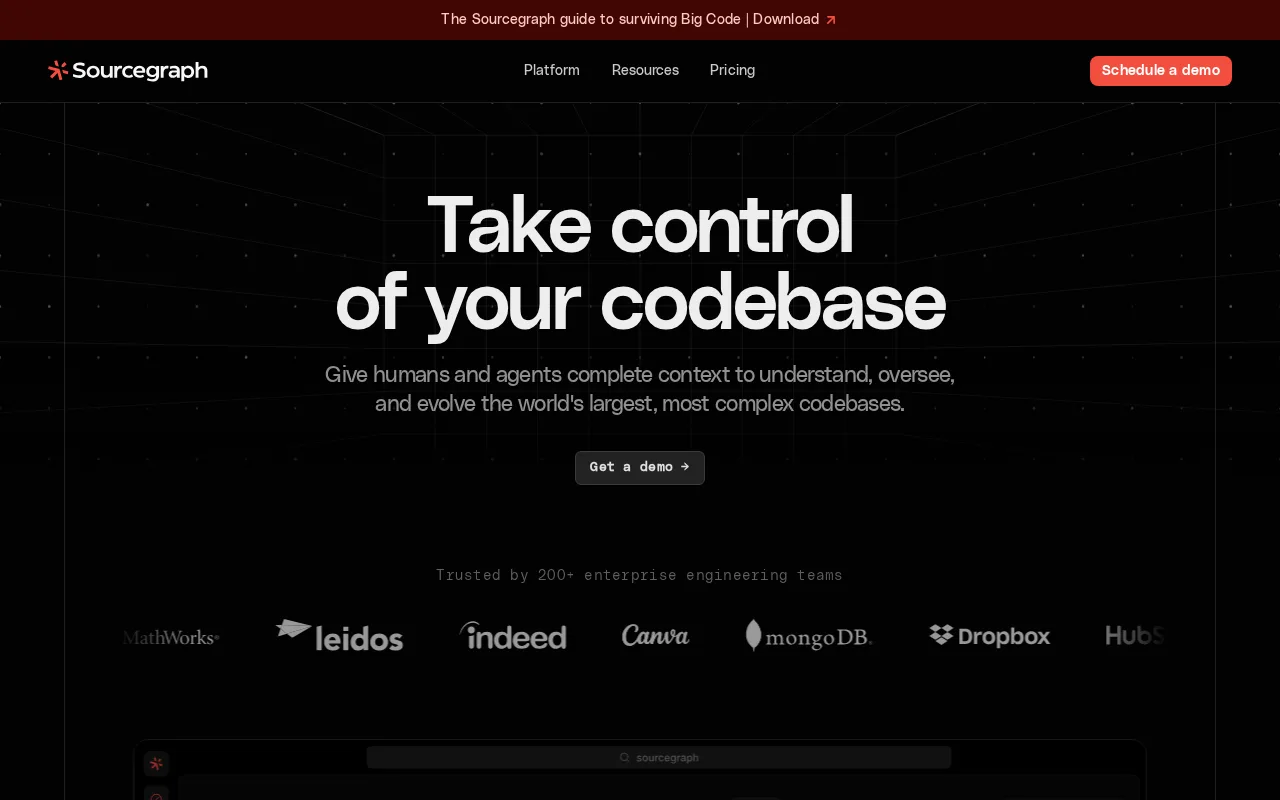
- Sourcegraph is a code search and navigation tool that helps developers explore and understand code across repositories.
- How much does it cost?
- Sourcegraph offers a free plan for individuals and paid plans for teams with advanced features and higher limits.
- Does it have a free plan?
- Yes, Sourcegraph provides a free plan suitable for individual developers with basic features.
- What integrations does it support?
- It integrates with popular code hosts like GitHub, GitLab, Bitbucket, and IDEs such as VS Code and JetBrains.
- Who is it best for?
- It is best for engineering teams needing fast, scalable code search and navigation across multiple repositories.
- What is this tool?
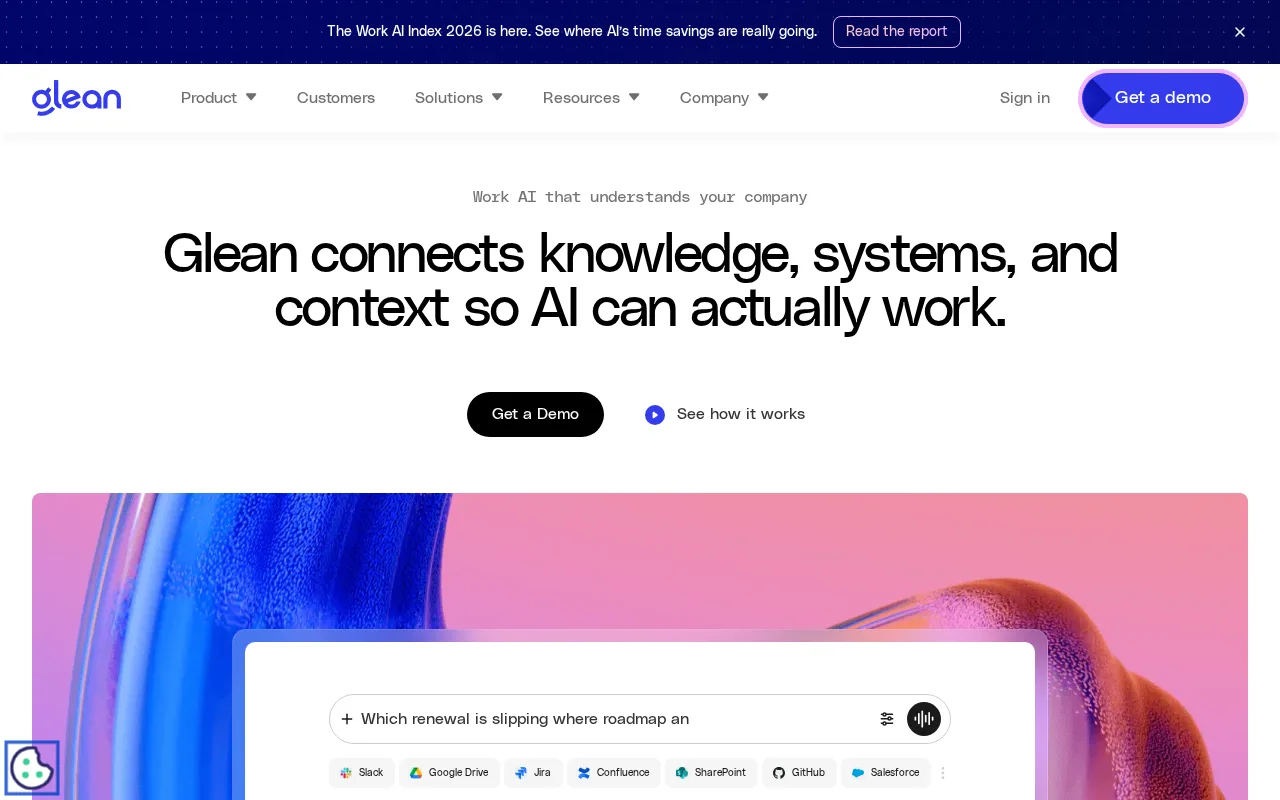
- Glean is a unified workplace search platform that indexes multiple apps and documents to help teams find information quickly.
- How much does it cost?
- Glean offers a free tier with basic features and paid plans for advanced capabilities and larger teams.
- Does it have a free plan?
- Yes, Glean provides a free plan suitable for individuals with limited usage.
- What integrations does it support?
- Glean integrates with Slack, Google Drive, Salesforce, and other popular workplace tools.
- Who is it best for?
- It is best for mid-sized to large teams needing unified search across multiple workplace applications.
| Info | Sourcegraph | Glean |
|---|---|---|
| Pricing | Freemium | Freemium |
| Category | AI Search & Answer Engines | AI Search & Answer Engines |
| Deployment | Cloud | Cloud |
| Learning Curve | Intermediate | Intermediate |
| Free Plan | ✓ | ✓ |
| AI Agent | ✗ | ✓ |
| Autonomy | Assistant | Assistant |
| Risk Tier | Low | Low |
 Pydantic Ai
 Openfang
Sourcegraph and Glean both offer freemium pricing models and have similar overall scores, with Sourcegraph at 5.7/10 and Glean at 5.6/10. Sourcegraph primarily focuses on code search and intelligence, catering to developers looking to improve code navigation and understanding across repositories. Glean, on the other hand, emphasizes knowledge discovery and search within organizational data, targeting broader enterprise knowledge management beyond just code. While Sourcegraph integrates deeply with developer workflows and supports multiple programming languages, Glean aims to unify information from various internal tools and documents to enhance employee productivity.
ⓘ How Volvenix scores work
Scores are computed by Volvenix — not supplied by the vendors, and not third-party benchmark results. Each 0–10 dimension (Overall, Features, Usability, Support, Pricing) is a directional estimate aggregated from catalog signals — editorial cataloguing, content depth, engagement, and provider-reputation indicators — so treat them as a starting point, not a lab result.
Confidence reflects how complete the underlying data is for both tools; lower confidence means fewer signals were available, not a worse tool. We never accept payment for rankings or scores. More about how Volvenix works →