 Volvenix
Describely vs Lily AI
AI-enhanced independent comparison — features, pros, cons, pricing and rankings.
 ChatGPT
  Claude
  Gemini
  Midjourney
  DALL-E
  Stable Diffusion
  Notion AI
  Canva
Canva  Grammarly
  GitHub Copilot
  ElevenLabs
  Perplexity
  Runway
  Synthesia
  Fireflies.ai
  Hugging Face Hub

| Dimension | Describely | Lily AI |
|---|---|---|
| Accuracy & Reliability | ||
| Ease of Use | ||
| Features & Capability | ||
| Value for Money | ||
| Performance & Speed | ||
| Popularity & Adoption |
Who each tool serves best — and when to pick the other one.
Retailers, brands, and agencies managing large product catalogs who need bulk SEO description generation and editing.
- You manage large product catalogs requiring bulk SEO description generation.
- You want to streamline product content workflows with bulk import and editing.
- Your team needs scalable automation for consistent product description output.
Small businesses or freelancers needing one-off copywriting or highly customized product descriptions.
- You need highly customized or creative one-off product descriptions.
- Free-tier limits prevent you from testing bulk features effectively.
- You require extensive third-party integrations or API access.
Ability to automate bulk SEO product description generation from catalog data efficiently.
Retailers, brands, and marketplaces needing scalable, accurate product catalog enrichment and attribute extraction.
- You need to enrich large retail catalogs with detailed product attributes automatically.
- You want to improve product search and personalization using accurate metadata.
- Your team requires a scalable solution for extracting attributes from images and text.
Businesses outside retail or e-commerce, or those requiring extensive API integrations and multi-domain AI capabilities.
- You need AI tools for domains outside retail or e-commerce product enrichment.
- Free-tier limits are a blocker for your catalog size or usage needs.
- You require extensive public API access or broad third-party integrations.
Accuracy and scalability of product attribute extraction tailored for retail taxonomies.
A canonical comparison across capabilities common to this category. Vendor-specific extras appear below in "Highlighted Features".
| Capability | Describely | Lily AI |
|---|---|---|
|
Text Generation
Produces human-like text from prompts
|
✓ | — |
|
Free Tier Available
Usable without payment (with usage limits)
|
✓ | ✓ |
Each tool's marketing-listed features. Where a feature appears under one tool but not the other, it usually reflects how the vendor describes their product — not a definitive capability gap.
- Bulk Import — Upload large product catalogs for batch description generation
- In-app Editing — Edit generated descriptions directly within the platform
- SEO optimization — Generate descriptions optimized for search engines
- Team collaboration — Collaborate on content with team members
- Custom Templates — Use templates for description styles
- Product Attribute Extraction — Extracts detailed attributes from images and text
- Retail Taxonomy Mapping — Maps attributes to retail-specific taxonomies
- Catalog Enrichment — Enhances product catalogs with rich metadata
- Search Improvement — Improves product search relevance
- Personalization Support — Supports personalized shopping experiences
- Bulk import and editing streamline workflows
- SEO-focused product description generation
- Supports large-scale catalog automation
- User-friendly interface for editing
- Freemium pricing allows trial of core features
- Accurate product attribute extraction from images and text
- Tailored for retail taxonomies and e-commerce catalogs
- Improves product search and personalization
- Scalable for large retail catalogs
- Supports retailers, brands, and marketplaces
- Limited customization for unique product descriptions
- Lacks API or third-party integrations
- No mobile app available
- Limited public API availability
- Narrow focus on retail limits broader applicability
- Automate SEO product descriptions for large e-commerce catalogs
- Bulk update product content for retail brands
- Streamline content workflows for agencies managing multiple clients
- Improve SEO rankings with optimized product descriptions
- Reduce manual copywriting time for product catalogs
- Enriching retail product catalogs with detailed attributes
- Improving product search accuracy in e-commerce
- Enhancing personalization for online shoppers
- Automating product metadata extraction at scale
- Supporting marketplace and brand catalog management
Natural languages each tool generates and understands. Primary languages are listed first.
What each tool can accept (input) and produce (output) — text, image, audio, video, code.
Offers a free plan with basic features and paid subscriptions for advanced bulk processing and editing capabilities.
-
Free
Free -
Pro
popular
$20.00/mo -
Team
$30.00/mo
Offers a free tier with basic features and paid plans for advanced usage and scalability.
-
Free
Free -
Pro
popular
$20.00/mo -
Team
$30.00/mo
Regulatory frameworks each tool claims compliance with (HIPAA, SOC 2, GDPR, etc.).
Vendor-published numbers each tool highlights — usage scale, breadth, and operational stats. Different tools track different metrics, so direct row-by-row comparison usually isn't meaningful.
- Time Saved Significant reduction in manual description writin
- SEO Impact Improved search rankings with optimized content
- Catalog Size Supported Large
- Accuracy High
How you can reach support — email, live chat, phone, community, docs.
- Email primary
- Documentation primary
How each tool is classified in the Volvenix catalog.
These vocabulary domains are managed in our catalog but not yet exposed at the tool level. We're tracking them for future expansion of this comparison.
- Encryption Types — AES-256, ChaCha20, RSA-2048, and similar at-rest/in-transit cipher families.
- Encryption Contexts — where encryption is applied (data at rest, in transit, end-to-end).
- Plan-tier Model Mapping — which AI models are available on which pricing tier (currently only the model list is tracked, not the per-plan availability).
- What is this tool?
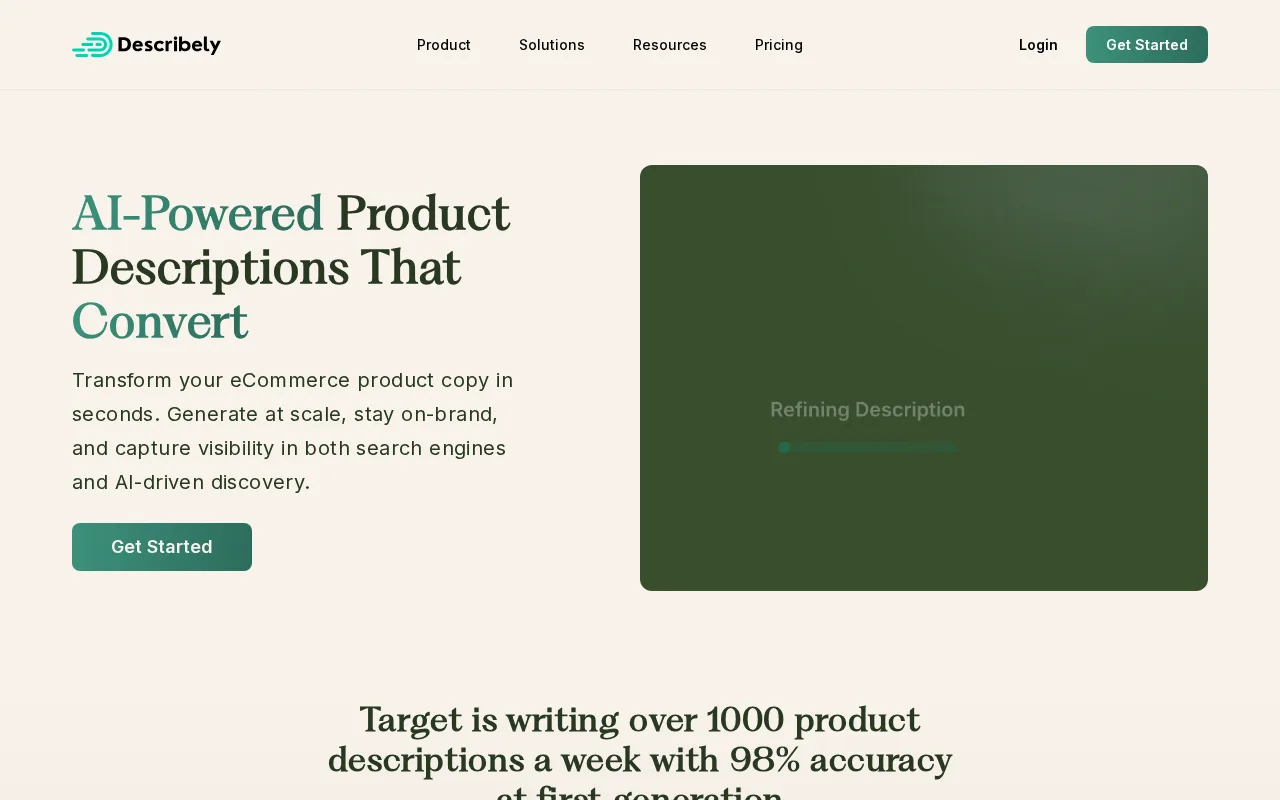
- Describely automates SEO-optimized product description generation from catalog data for retailers and agencies.
- How much does it cost?
- Describely offers a free plan and paid subscriptions starting at $20 per month.
- Does it have a free plan?
- Yes, there is a free plan with basic features and limited bulk imports.
- What integrations does it support?
- No public integrations or API are currently available.
- Who is it best for?
- It is best for retailers, brands, and agencies needing bulk SEO product description automation.
- What is this tool?
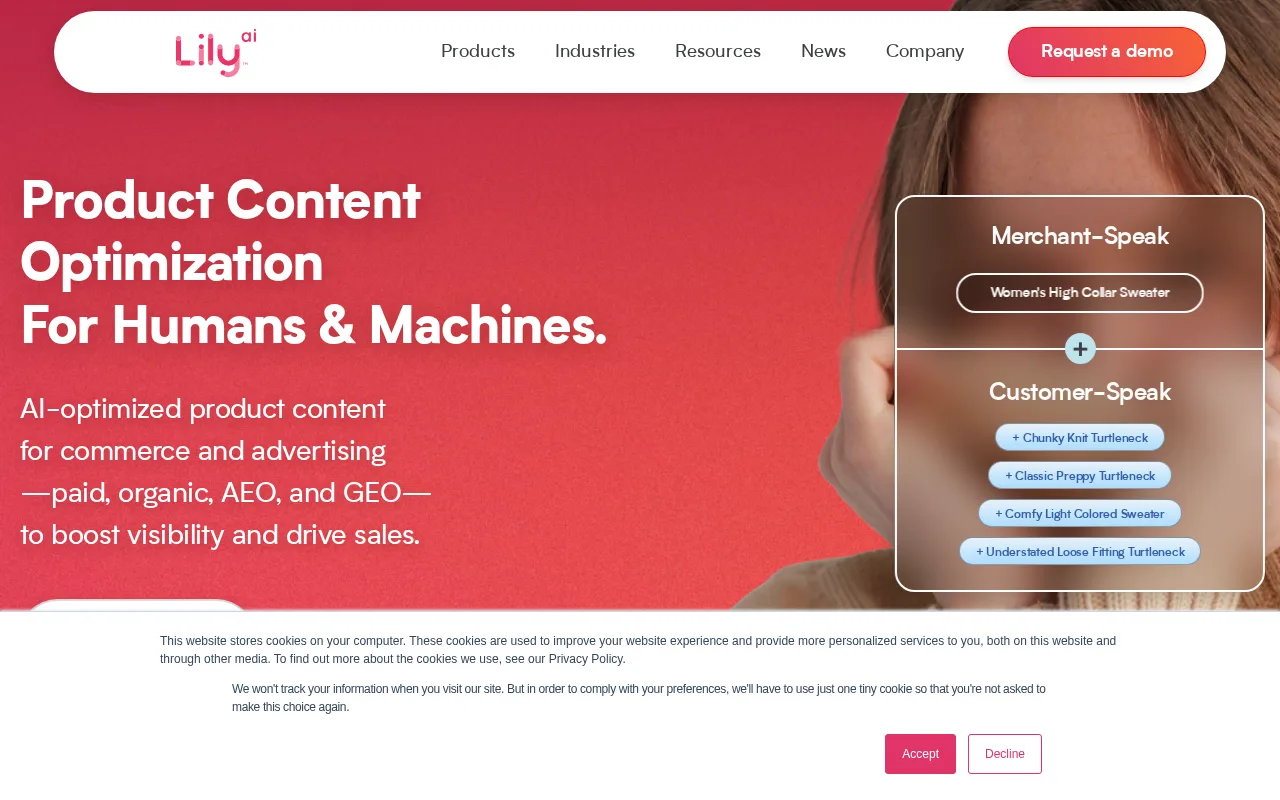
- Lily AI extracts detailed product attributes from images and text to enrich retail catalogs.
- How much does it cost?
- Lily AI offers a freemium pricing model with free and paid subscription tiers.
- Does it have a free plan?
- Yes, Lily AI provides a free plan with basic features and limited catalog size.
- What integrations does it support?
- Public information on integrations is limited; no prominent native integrations are documented.
- Who is it best for?
- It is best for retailers, brands, and marketplaces needing scalable product catalog enrichment.
| Info | Describely | Lily AI |
|---|---|---|
| Pricing | Freemium | Freemium |
| Category | E-Commerce, Retail & Shopping AI | E-Commerce, Retail & Shopping AI |
| Deployment | Cloud | Cloud |
| Free Plan | ✓ | ✓ |
| AI Agent | ✗ | ✓ |
| Autonomy | Assistant | Assistant |
| Risk Tier | Medium | Medium |
 Synthesys X
 Constructor
 Topic
Topic Klevu Smart Search
 FusionMedia AI
 Syte Visual AI
 UpContent
 Kialo Edu
Lily AI and Describely both offer freemium pricing models, making them accessible for users seeking entry-level options. Lily AI has an overall score of 5.2/10 and focuses on enhancing product discovery through AI-driven attribute tagging and personalization, primarily serving e-commerce businesses. Describely, with a slightly higher overall score of 5.6/10, emphasizes automated product description generation and content optimization, catering to retailers looking to improve product content efficiency. While both tools support e-commerce use cases, Lily AI leans more toward personalization and search relevance, whereas Describely specializes in content creation and SEO enhancement.
ⓘ How Volvenix scores work
Scores are computed by Volvenix — not supplied by the vendors, and not third-party benchmark results. Each 0–10 dimension (Overall, Features, Usability, Support, Pricing) is a directional estimate aggregated from catalog signals — editorial cataloguing, content depth, engagement, and provider-reputation indicators — so treat them as a starting point, not a lab result.
Confidence reflects how complete the underlying data is for both tools; lower confidence means fewer signals were available, not a worse tool. We never accept payment for rankings or scores. More about how Volvenix works →