 Volvenix
Nansen vs Chainalysis
AI-enhanced independent comparison — features, pros, cons, pricing and rankings.
 ChatGPT
  Claude
  Gemini
  Midjourney
  DALL-E
  Stable Diffusion
  Notion AI
  Canva
Canva  Grammarly
  GitHub Copilot
  ElevenLabs
  Perplexity
  Runway
  Synthesia
  Fireflies.ai
  Hugging Face Hub

| Dimension | Nansen | Chainalysis |
|---|---|---|
| Accuracy & Reliability | ||
| Ease of Use | ||
| Features & Capability | ||
| Value for Money | ||
| Performance & Speed | ||
| Popularity & Adoption |
Who each tool serves best — and when to pick the other one.
Active crypto investors, traders, and institutional teams seeking detailed on-chain analytics and wallet intelligence.
- You need granular, real-time analytics on wallet flows and DeFi yields across multiple blockchains.
- You want to identify smart money movements and receive actionable alerts for on-chain activity.
- Your team requires customizable dashboards and advanced wallet labeling for due diligence or research.
Casual crypto users or beginners who need simple portfolio tracking or are unwilling to pay for advanced analytics.
- You need only basic portfolio tracking without advanced analytics or wallet intelligence features.
- Free-tier limits are a blocker for you and you do not plan to upgrade to a paid plan.
- You require integrations with traditional finance tools or exchanges not focused on DeFi analytics.
Depth and breadth of real-time on-chain analytics and wallet intelligence.
Compliance teams, financial institutions, and government agencies focused on cryptocurrency fraud detection and AML enforcement.
- You need to monitor cryptocurrency transactions for compliance and fraud detection.
- You want detailed blockchain data to investigate suspicious activity effectively.
- Your team requires real-time alerts and comprehensive crypto risk analytics.
Small startups or individual users with limited budgets or those not requiring deep blockchain analytics.
- You need a low-cost or fully transparent pricing model for small-scale use.
- Free-tier limits are a blocker for your organization's compliance needs.
- You require a fully open-source blockchain analytics solution.
Depth and accuracy of blockchain transaction data and analytics for fraud detection.
A canonical comparison across capabilities common to this category. Vendor-specific extras appear below in "Highlighted Features".
| Capability | Nansen | Chainalysis |
|---|---|---|
|
Free Tier Available
Usable without payment (with usage limits)
|
✓ | ✓ |
Each tool's marketing-listed features. Where a feature appears under one tool but not the other, it usually reflects how the vendor describes their product — not a definitive capability gap.
- Real-time wallet analytics — Track wallet activity and token flows across blockchains
- DeFi yield tracking — Monitor DeFi yields and liquidity pools in real time
- Wallet labeling — Identify and label wallets for deeper insights
- Smart alerts — Receive notifications for significant wallet or token activity
- Custom dashboards — Build personalized analytics dashboards
- Transaction monitoring — Tracks and analyzes blockchain transactions for suspicious activity
- Risk Scoring — Assigns risk scores to wallet addresses and transactions
- Investigations — Tools for tracing illicit funds and generating reports
- Compliance Reporting — Supports AML and KYC compliance workflows
- Cryptocurrency Coverage — Supports Bitcoin, Ethereum, and multiple other blockchains
- Granular on-chain wallet analytics
- Real-time DeFi yield tracking
- Unique wallet labeling
- Customizable dashboards
- Smart alerts for wallet activity
- Comprehensive blockchain transaction data
- Strong AML compliance and fraud detection capabilities
- Real-time alerts and investigative tools
- Widely adopted by regulators and financial institutions
- Supports multiple cryptocurrencies and blockchains
- Steep learning curve for new users
- Free plan has limited features and data access
- No public API for custom integrations
- Lack of transparent pricing information
- Limited free plan features
- No public API documentation available
- Monitor whale wallet movements
- Track DeFi protocol yields
- Conduct due diligence on token projects
- Identify smart money trends
- Analyze cross-chain wallet activity
- AML compliance for cryptocurrency exchanges
- Fraud detection in blockchain transactions
- Government investigations of illicit crypto activity
- Risk assessment for crypto asset management
- Transaction monitoring for financial institutions
Natural languages each tool generates and understands. Primary languages are listed first.
What each tool can accept (input) and produce (output) — text, image, audio, video, code.
Nansen offers a free plan with limited features and paid subscriptions for advanced analytics and team access.
-
Free
Free -
Pro
popular
$20.00/mo -
Team
$30.00/mo
Offers a freemium model with limited free access; detailed pricing requires contacting sales.
-
Free
Free
Regulatory frameworks each tool claims compliance with (HIPAA, SOC 2, GDPR, etc.).
Third-party audits and certifications that verify security controls.
No certifications listed.
Vendor-published numbers each tool highlights — usage scale, breadth, and operational stats. Different tools track different metrics, so direct row-by-row comparison usually isn't meaningful.
- Blockchains Supported 10+
- Wallets Labeled 100M+
- Trusted by 100+ institutions
Who each tool is positioned for — primary audience first.
No specific audience listed.
How you can reach support — email, live chat, phone, community, docs.
- Discord primary
- Email primary
How each tool is classified in the Volvenix catalog.
These vocabulary domains are managed in our catalog but not yet exposed at the tool level. We're tracking them for future expansion of this comparison.
- Encryption Types — AES-256, ChaCha20, RSA-2048, and similar at-rest/in-transit cipher families.
- Encryption Contexts — where encryption is applied (data at rest, in transit, end-to-end).
- Plan-tier Model Mapping — which AI models are available on which pricing tier (currently only the model list is tracked, not the per-plan availability).
- What is this tool?
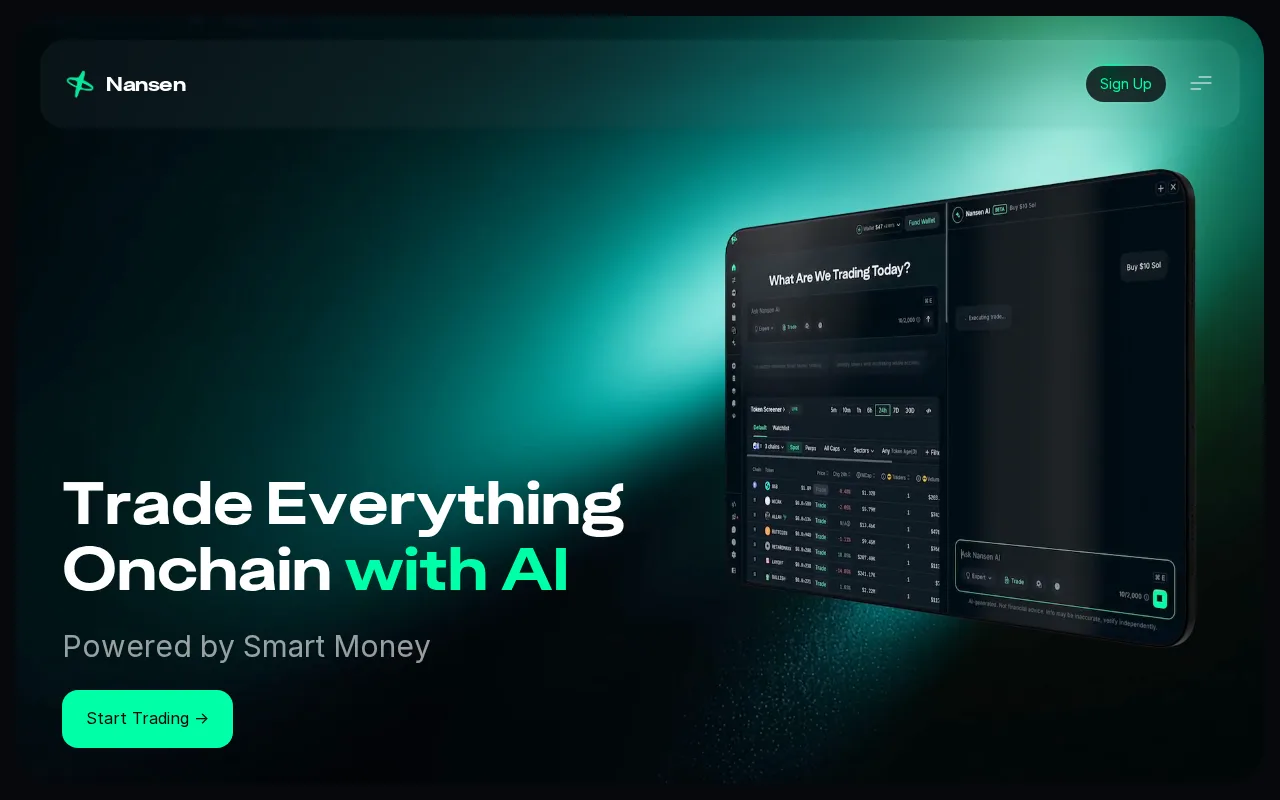
- Nansen is a blockchain analytics platform for tracking wallet activity, token flows, and DeFi yields.
- How much does it cost?
- Nansen offers a free plan and paid subscriptions starting at $20/month for advanced features.
- Does it have a free plan?
- Yes, Nansen provides a free plan with limited analytics and dashboard access.
- What integrations does it support?
- Nansen does not currently offer direct integrations with external platforms or a public API.
- Who is it best for?
- It is best for active crypto investors, traders, and institutions needing deep on-chain analytics.
- What is this tool?
- Chainalysis is a blockchain analytics platform that helps detect fraud and ensure compliance in cryptocurrency transactions.
- How much does it cost?
- Chainalysis offers a freemium model with limited free access; detailed pricing requires contacting sales.
- Does it have a free plan?
- Yes, Chainalysis provides a free plan with basic features suitable for individuals or small teams.
- What integrations does it support?
- Chainalysis integrates primarily as a cloud platform; specific third-party integrations are not publicly detailed.
- Who is it best for?
- It is best suited for compliance teams, financial institutions, and government agencies focused on cryptocurrency fraud detection.
| Info | Nansen | Chainalysis |
|---|---|---|
| Pricing | Freemium | Freemium |
| Category | Finance, Banking & Fintech AI | Finance, Banking & Fintech AI |
| Deployment | Cloud | Cloud |
| Learning Curve | — | Advanced |
| Free Plan | ✓ | ✓ |
| AI Agent | ✗ | ✗ |
| Autonomy | Assistant | Copilot |
| Risk Tier | Medium | Medium |
 Forta
Forta Fetch.ai
 Kryll
Kryll Merkle Science
 Solidus Labs Market Surveillance
 Hawk
Hawk AnChain.AI
 Lucinity
Nansen and Chainalysis both offer freemium pricing models and have similar overall scores, with Nansen at 5.3/10 and Chainalysis at 5.4/10. Nansen focuses on on-chain data analytics and wallet labeling to support NFT and DeFi users, while Chainalysis specializes in blockchain compliance, investigation, and risk management for law enforcement and financial institutions. Their feature sets reflect these use cases, with Nansen emphasizing market insights and Chainalysis providing tools for transaction monitoring and regulatory reporting.
ⓘ How Volvenix scores work
Scores are computed by Volvenix — not supplied by the vendors, and not third-party benchmark results. Each 0–10 dimension (Overall, Features, Usability, Support, Pricing) is a directional estimate aggregated from catalog signals — editorial cataloguing, content depth, engagement, and provider-reputation indicators — so treat them as a starting point, not a lab result.
Confidence reflects how complete the underlying data is for both tools; lower confidence means fewer signals were available, not a worse tool. We never accept payment for rankings or scores. More about how Volvenix works →