 Volvenix
Arize AI vs Openllmetry
AI-enhanced independent comparison — features, pros, cons, pricing and rankings.
 ChatGPT
  Claude
  Gemini
  Midjourney
  DALL-E
  Stable Diffusion
  Notion AI
  Canva
Canva  Grammarly
  GitHub Copilot
  ElevenLabs
  Perplexity
  Runway
  Synthesia
  Fireflies.ai
  Hugging Face Hub

| Dimension | Arize AI | Openllmetry |
|---|---|---|
| Accuracy & Reliability | ||
| Ease of Use | ||
| Features & Capability | ||
| Value for Money | ||
| Performance & Speed | ||
| Popularity & Adoption |
Who each tool serves best — and when to pick the other one.
ML engineering and data science teams in enterprises requiring advanced model monitoring and debugging capabilities.
- You need to monitor both classic ML and modern LLM models in production environments.
- You want to detect data drift and model performance issues early to reduce downtime.
- Your team requires integrated debugging tools alongside monitoring for faster issue resolution.
Small startups or individual practitioners with limited budgets or those seeking simple, low-cost monitoring solutions.
- You need a free or low-cost solution suitable for individual users or small teams.
- Free-tier limits are a blocker for your team’s experimentation or early-stage projects.
- You require simple monitoring without integrated debugging or evaluation features.
Comprehensive ML and LLM observability with integrated debugging and evaluation workflows.
Developers and small teams needing detailed tracing and logging for LLMs in development or production environments.
- You need detailed tracing of LLM calls and workflows for debugging or analysis.
- You want an open-source tool with a freemium pricing model for LLM observability.
- Your team requires real-time monitoring of LLM performance and behavior.
Large enterprises requiring extensive integrations, advanced security, or turnkey monitoring solutions should consider other tools.
- You need a fully managed enterprise monitoring platform with broad integrations.
- Free-tier limits are a blocker for your high-volume LLM usage scenarios.
- You require built-in advanced security certifications and compliance features.
The depth and specificity of LLM tracing and logging capabilities.
A canonical comparison across capabilities common to this category. Vendor-specific extras appear below in "Highlighted Features".
| Capability | Arize AI | Openllmetry |
|---|---|---|
|
Free Tier Available
Usable without payment (with usage limits)
|
— | ✓ |
Each tool's marketing-listed features. Where a feature appears under one tool but not the other, it usually reflects how the vendor describes their product — not a definitive capability gap.
- Performance monitoring — Track model accuracy, drift, and other metrics in real time
- Data Drift Detection — Detect shifts in input data distributions affecting model outputs
- LLM Quality Evaluation — Evaluate large language model outputs for quality and consistency
- Integrated Debugging Tools — Tools to investigate and resolve model performance issues
- Custom Metrics and Alerts — Configure alerts based on custom thresholds and metrics
- LLM Tracing — Detailed tracing of LLM calls and workflows
- Logging — Centralized logging for LLM operations
- Real-time monitoring — Live observability of LLM performance
- Integrations — Limited third-party tool integrations
- Open-source SDK — Community-driven SDK for customization
- Detailed ML and LLM model monitoring
- Unified platform for monitoring, debugging, and evaluation
- Supports detection of data drift and performance degradation
- Enterprise-grade scalability and reliability
- Specialized for LLM tracing and logging
- Open-source with community support
- Freemium pricing lowers entry barriers
- Real-time observability features
- Lightweight and developer-friendly
- Pricing is not publicly available and targets enterprises
- No free or trial plans for initial evaluation
- Limited third-party integrations
- No advanced enterprise security features
- Lacks mobile or desktop apps
- Detecting data drift in production ML models
- Monitoring LLM output quality and consistency
- Debugging model performance issues quickly
- Evaluating model updates before deployment
- Ensuring compliance with model performance SLAs
- Debugging LLM workflows
- Monitoring LLM performance in production
- Logging LLM request and response data
- Analyzing LLM latency and errors
- Developing custom LLM observability tools
Natural languages each tool generates and understands. Primary languages are listed first.
What each tool can accept (input) and produce (output) — text, image, audio, video, code.
Pricing is enterprise-based and not publicly disclosed; contact sales for custom quotes.
-
Custom (Contact Sales)
Custom pricing
Offers a free tier with basic features and paid plans for enhanced usage and capabilities.
-
Free
Free
Regulatory frameworks each tool claims compliance with (HIPAA, SOC 2, GDPR, etc.).
None listed.
Languages, frameworks, databases, and infrastructure each tool is built on. Mostly relevant for self-hosted or open-source tools.
Stack not disclosed.
Who each tool is positioned for — primary audience first.
How each tool is classified in the Volvenix catalog.
These vocabulary domains are managed in our catalog but not yet exposed at the tool level. We're tracking them for future expansion of this comparison.
- Encryption Types — AES-256, ChaCha20, RSA-2048, and similar at-rest/in-transit cipher families.
- Encryption Contexts — where encryption is applied (data at rest, in transit, end-to-end).
- Plan-tier Model Mapping — which AI models are available on which pricing tier (currently only the model list is tracked, not the per-plan availability).
- What is this tool?
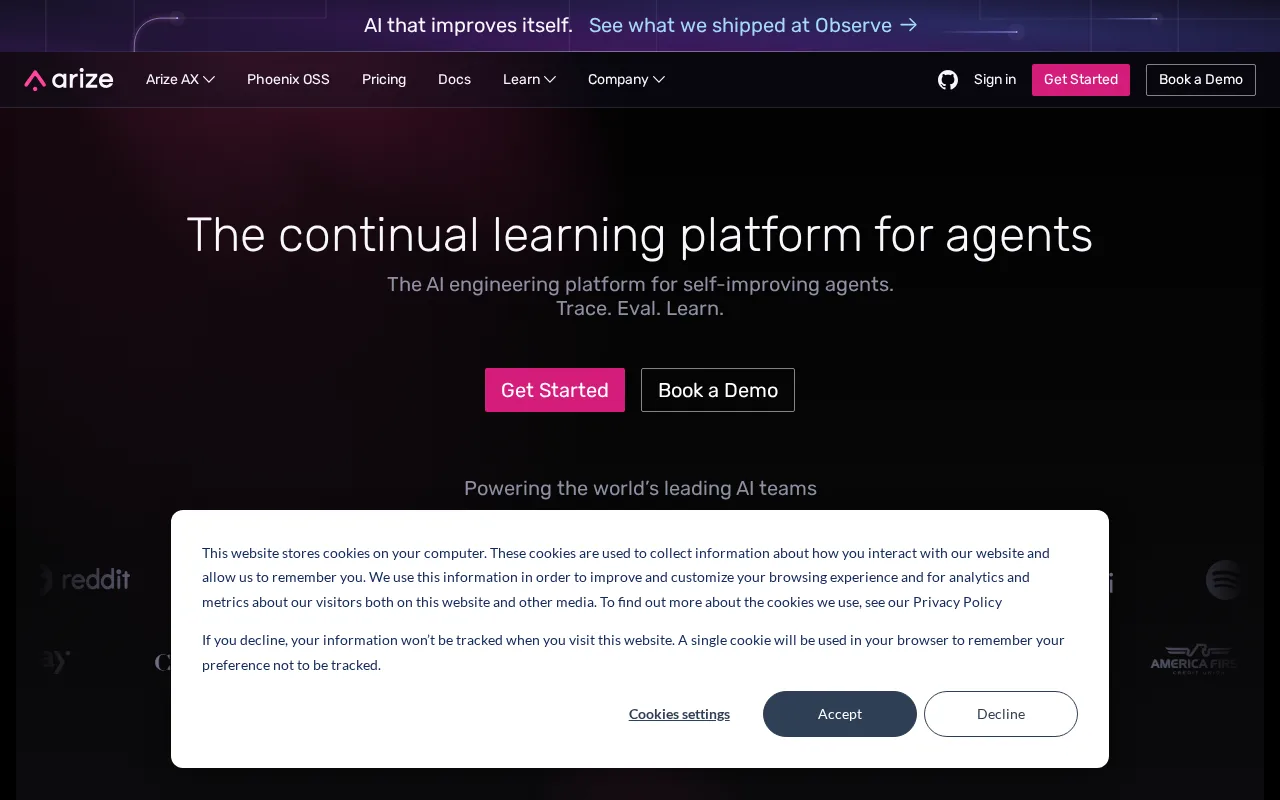
- Arize AI is a platform for monitoring and debugging machine learning and large language models in production.
- How much does it cost?
- Pricing is enterprise-based and not publicly disclosed; interested users must contact sales.
- Does it have a free plan?
- No, Arize AI does not offer a free or trial plan publicly.
- What integrations does it support?
- Arize AI integrates with common ML platforms and data sources; specific integrations are detailed in their documentation.
- Who is it best for?
- It is best suited for enterprise ML engineering and data science teams needing advanced observability and debugging.
- What is this tool?
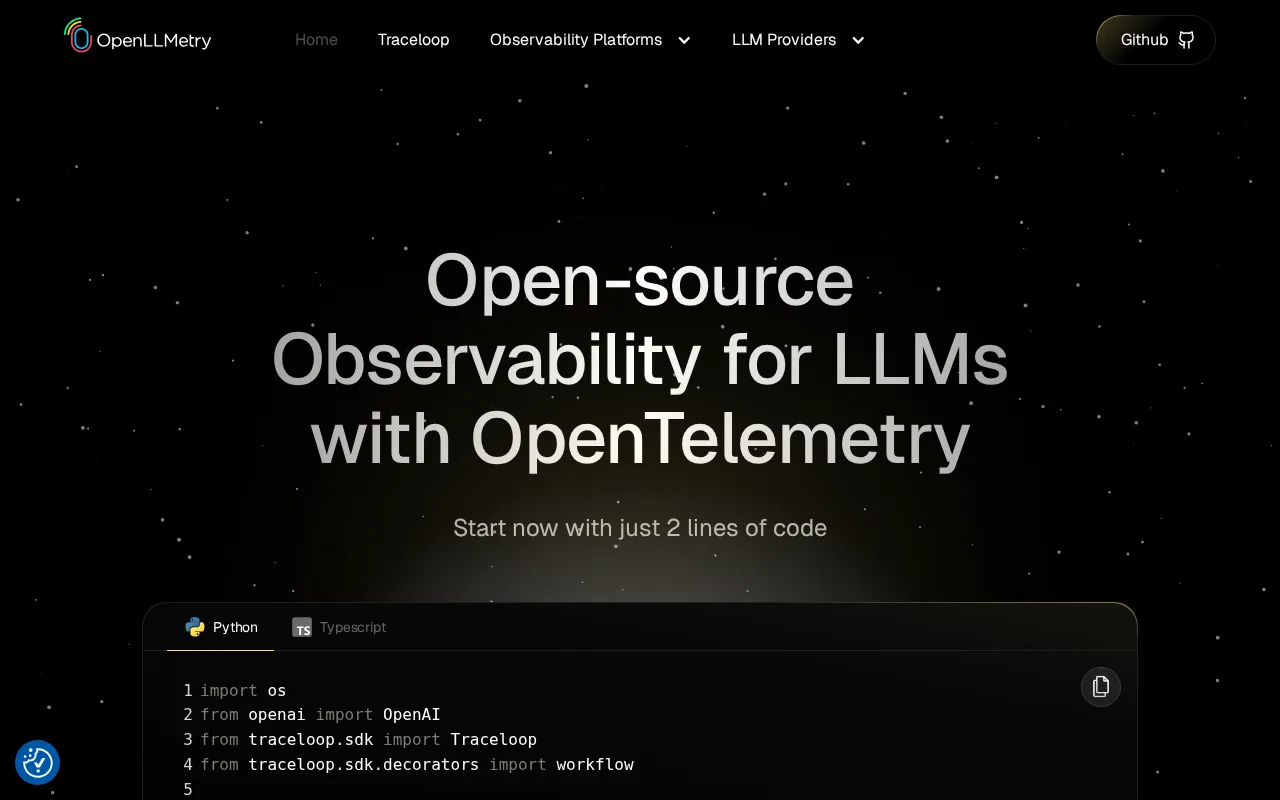
- Openllmetry is an open-source observability tool focused on tracing and logging for large language models.
- How much does it cost?
- Openllmetry offers a free tier with basic features; paid plans are available for higher usage and advanced capabilities.
- Does it have a free plan?
- Yes, Openllmetry provides a free plan suitable for individuals and small projects.
- What integrations does it support?
- It supports limited third-party integrations, primarily focusing on core LLM tracing and logging.
- Who is it best for?
- It is best suited for developers and small teams needing detailed LLM observability and monitoring.
| Info | Arize AI | Openllmetry |
|---|---|---|
| Pricing | Enterprise | Freemium |
| Category | Machine Learning Models & Algorithms | LLM Observability & Monitoring |
| Deployment | Cloud | Cloud |
| Learning Curve | Intermediate | Intermediate |
| Free Plan | ✗ | ✓ |
| AI Agent | ✗ | ✗ |
| Autonomy | Copilot | Assistant |
| Risk Tier | Medium | Low |
 Evidently AI
 Datadog LLM Observability
 Langfuse
 Confident AI
 Traceloop
 Portkey
Arize AI and OpenTelemetry both have an overall score of 5.4/10 but differ in pricing and focus. Arize AI offers enterprise-level pricing and is primarily designed for machine learning observability and model performance monitoring. OpenTelemetry provides a freemium pricing model and focuses on collecting telemetry data such as metrics, logs, and traces for distributed systems monitoring and observability.
ⓘ How Volvenix scores work
Scores are computed by Volvenix — not supplied by the vendors, and not third-party benchmark results. Each 0–10 dimension (Overall, Features, Usability, Support, Pricing) is a directional estimate aggregated from catalog signals — editorial cataloguing, content depth, engagement, and provider-reputation indicators — so treat them as a starting point, not a lab result.
Confidence reflects how complete the underlying data is for both tools; lower confidence means fewer signals were available, not a worse tool. We never accept payment for rankings or scores. More about how Volvenix works →